Blog
Selank in Stress-Response Research

Selank appears across several corners of neuropeptide research, and one of the most active is the study of stress-response systems. As a synthetic analogue of the immune peptide tuftsin, developed in Russia, Selank sits at the intersection of neuropeptide signalling and the body’s regulatory stress pathways. This profile looks at why it features in that literature and what to consider when working with it.
The systems stress research cares about
Stress-response research often centres on the hypothalamic-pituitary-adrenal (HPA) axis, the signalling cascade that coordinates how an organism regulates stress. Compounds studied in this area are of interest when they interact with, or help probe, the neuropeptide systems that feed into that axis. Selank is examined in exactly this framing: as a regulatory neuropeptide rather than a blunt activator or suppressor.
Why Selank fits the regulatory framing
Several features explain why Selank recurs in stress-response literature:
- Tuftsin origin. Selank is derived from a naturally occurring regulatory peptide, which links it to endogenous signalling systems rather than to a synthetic mechanism with no biological precedent.
- Modulatory character. It is studied as a compound associated with balance and regulation, which is the language stress-response research tends to use.
- Engineered stability. The structural modifications in Selank are meant to make it more robust than the natural fragment, an advantage in experiments that need consistent material over time.
The important distinction is that these are reasons Selank is studied in this context, not assertions about what it does in any organism. A useful profile maps the terrain of the research so that work can be designed accurately, and it clarifies why a given compound keeps surfacing in a particular body of literature. In the case of Selank, the through-line is its identity as a regulatory neuropeptide with a natural precedent, which is precisely the kind of profile stress-response models tend to reach for.
Selank at a glance
| Attribute | Selank |
|---|---|
| Class | Regulatory neuropeptide |
| Derived from | Tuftsin (immune peptide fragment) |
| Origin | Russia |
| Research context | Stress-response and HPA-axis studies |
Consistency in long studies
Stress-response research frequently unfolds over extended timelines and repeated measurements. That makes reproducibility a central concern: if the peptide itself drifts in identity or purity between lots, it becomes very difficult to attribute a result to the compound rather than to variation in the material. Selank, like all peptides, is also sensitive to heat, light, and repeated freeze-thaw handling, so both storage discipline and sourcing quality directly affect the reliability of the data.
LYFE Science verifies every compound by HPLC and mass spectrometry and provides a certificate of analysis for the lot you receive, so the neuropeptide anchoring your study is documented from the start.
Related reading
Because Selank is one of a small group of Russian-developed neuropeptides, researchers often study it alongside its close relatives and compare their profiles. If the neuropeptide category is new to you, our peptide guide covers the fundamentals and vocabulary you will need to navigate it confidently.
Ordering in Canada
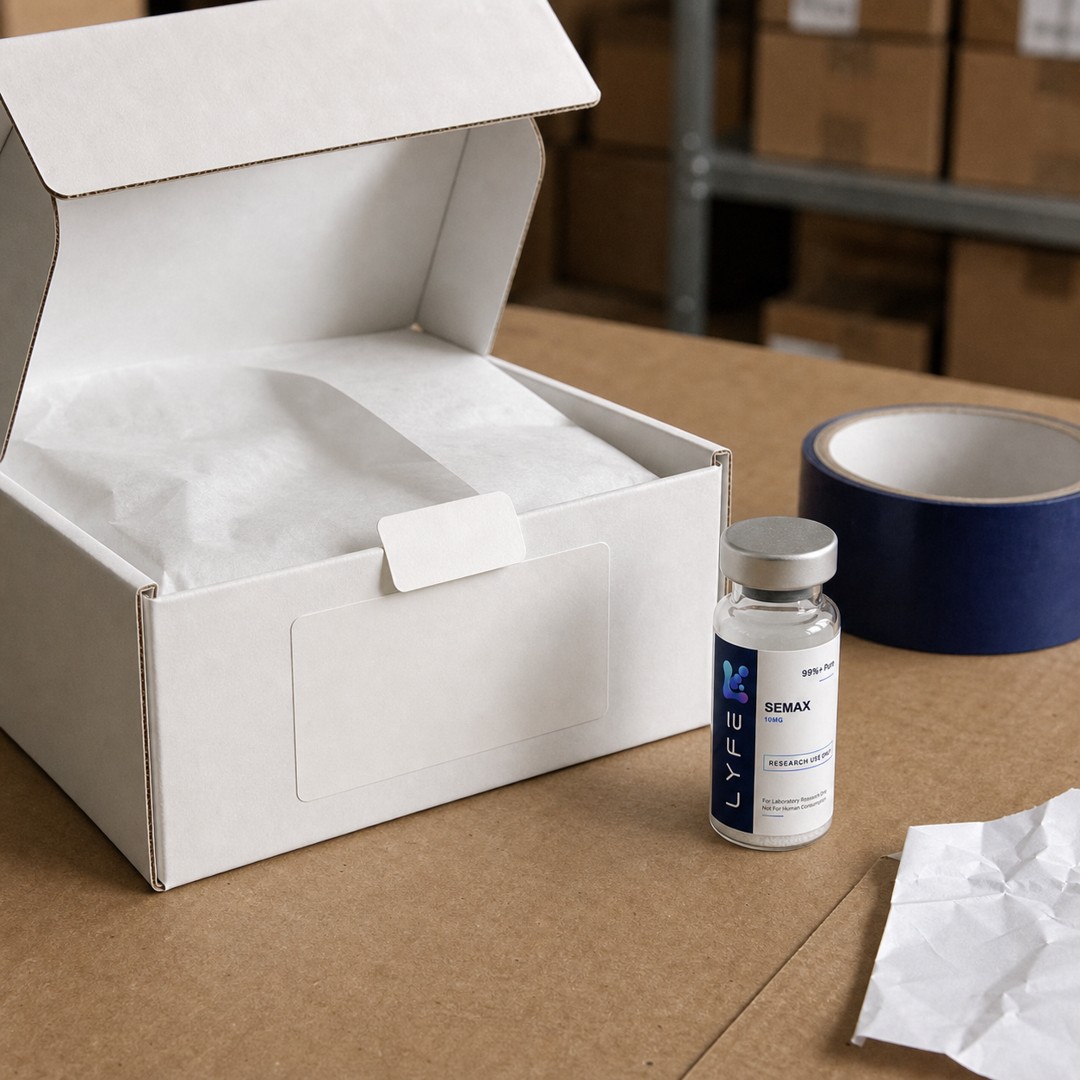
LYFE Science is a Canadian supplier shipping nationwide by Canada Post. Shipping is a flat $25 and free over $150, sent in neutral packaging, with same-day dispatch on orders paid before noon ET and delivery typically within one to three business days for most of Canada. Payment is by Interac e-Transfer or crypto (BTC, ETH, SOL, USDC, USDT).
Selank has earned a durable place in stress-response research as a stabilised, tuftsin-derived neuropeptide studied for its role in regulatory signalling. Pair it with careful handling and a well-documented lot, and it becomes a solid foundation for work in this area.
Follow along
Research, lab-side
@lyfe_science →