Blog
How to Store Peptides Properly (Canada)

Peptides are delicate molecules, and how you store them has a direct effect on how long they stay intact. Good storage habits are the cheapest quality control you have. This guide covers the essentials for keeping both sealed and reconstituted vials stable.
The three things that degrade peptides
Heat, light and moisture are the main enemies. Heat accelerates chemical breakdown, ultraviolet light can damage sensitive sequences, and moisture invites both hydrolysis and microbial growth. Repeated temperature swings, such as taking a vial in and out of the fridge, are harder on a peptide than one steady cold environment.
Storing sealed, lyophilised vials
In their freeze-dried powder form, peptides are at their most stable. Kept sealed, cold and dry, they hold up well over an extended period. A refrigerator is fine for the near term, and a freezer is the better choice for longer storage. Keep vials in their original packaging, away from light, and let them come to room temperature before opening to avoid condensation drawing moisture into the powder.
Storing reconstituted vials
Once a peptide is in solution it becomes far more fragile and has a much shorter usable window. Reconstituted material should be kept refrigerated, protected from light, and handled cleanly to avoid contamination. Solutions are best kept undisturbed rather than shaken, and left in the coldest stable part of the fridge rather than the door, where the temperature fluctuates most.
Freezing and thawing
- Freeze sealed powder for long-term storage, not solutions you plan to use soon.
- Avoid repeated freeze-thaw cycles; each one stresses the molecule.
- Thaw slowly and gently, ideally in the fridge rather than at room temperature or with heat.
- Keep a desiccant nearby to control humidity if you store powder outside the fridge briefly.
Why storage decides your results
Storage is not a side detail; it is quality control you perform yourself. A vial that starts at high purity can drift downward if it is left warm, exposed to light, or thawed and refrozen repeatedly. Because that degradation is usually invisible, the first sign of a poorly stored peptide is often an experiment that will not reproduce. Treating storage as seriously as sourcing is the cheapest way to protect your work.
Common storage mistakes to avoid
- Storing solutions in the fridge door. The door is the warmest, most variable spot; use a shelf deeper inside.
- Opening a cold vial straight away. Condensation forms on cold glass and pulls moisture into the powder. Let it reach room temperature first.
- Refreezing solutions. Reconstituted material does not benefit from freeze-thaw cycles.
- Leaving vials in light. Keep them in their box or a dark container.
- Losing track of dates. Label with the arrival date and lot number so you know a vial’s history at a glance.
Handling on arrival
When a shipment reaches you, get sealed vials into cold storage promptly. Peptides tolerate short transit at ambient temperature, which is why careful suppliers ship quickly, but they are not meant to sit warm for days. Inspect each vial for an intact seal and a clean, uniform powder before storing.
Buying from a supplier that ships carefully
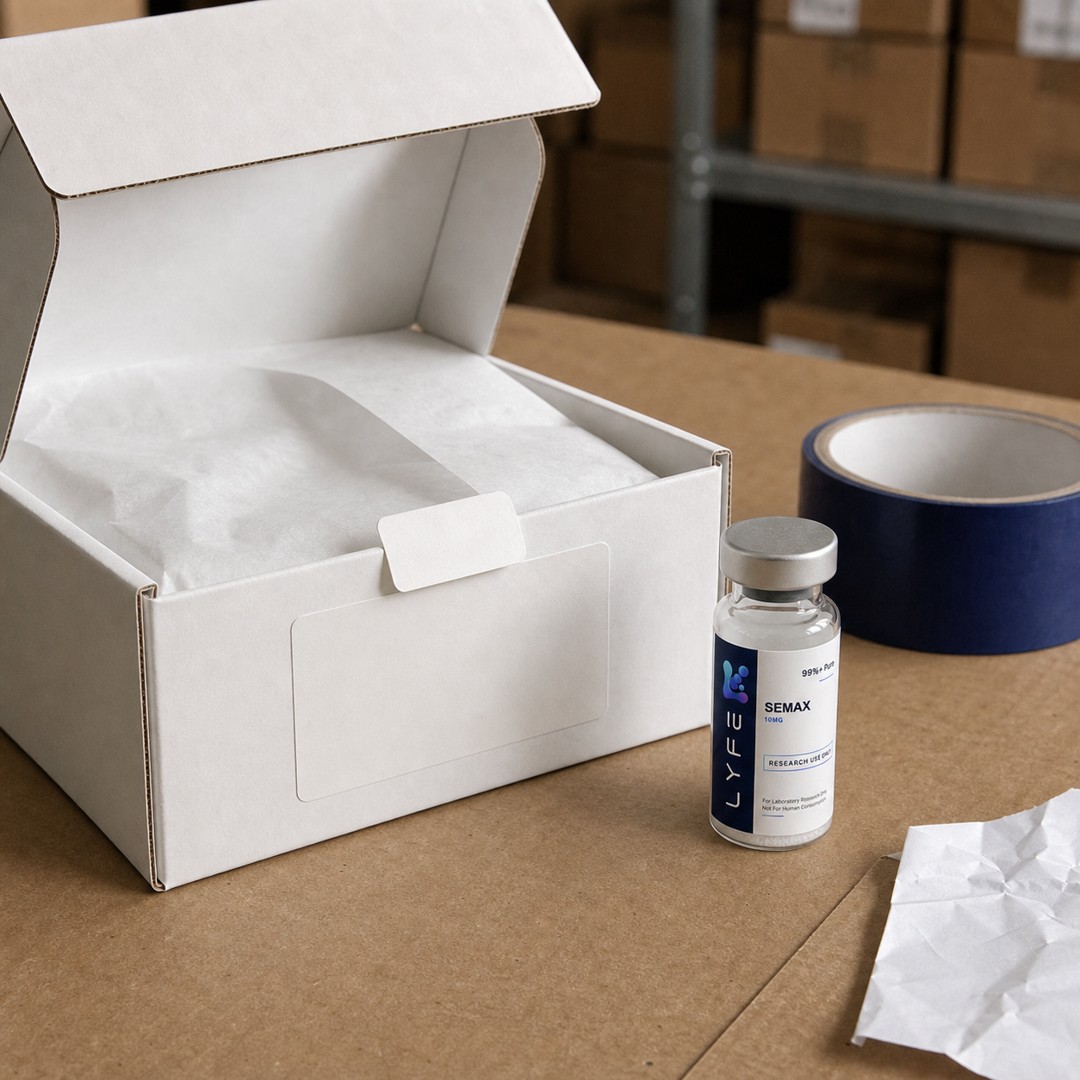
Storage starts with how the material reaches you. LYFE Science is a Canadian supplier that ships coast to coast with Canada Post. Shipping is a flat $25 and free on orders over $150, dispatched the same day when payment clears before noon Eastern and arriving in one to three business days across most of the country. Packaging is plain and unbranded. Payment is by Interac e-Transfer or crypto (BTC, ETH, SOL, USDC, USDT). Fast dispatch and short Canadian transit times mean your peptides spend less time in transit and more time in proper storage. Every lot is checked by HPLC and mass spectrometry with a COA available, so you know exactly what you are putting into storage in the first place.
Follow along
Research, lab-side
@lyfe_science →