Blog
TB-500 vs MOTS-c: Canada Buyer’s Guide

TB-500 and MOTS-c both show up on Canadian research shopping lists, and buyers often ask how the two compare. The honest answer is that they sit in almost completely different corners of peptide science. TB-500 is studied for the way it influences the cytoskeleton, cell movement and tissue remodelling, while MOTS-c is a mitochondrial-derived peptide studied for its role in cellular metabolism and energy signalling. This guide breaks down what each one is, where they overlap, and how to choose between them when you order in Canada.
What TB-500 is
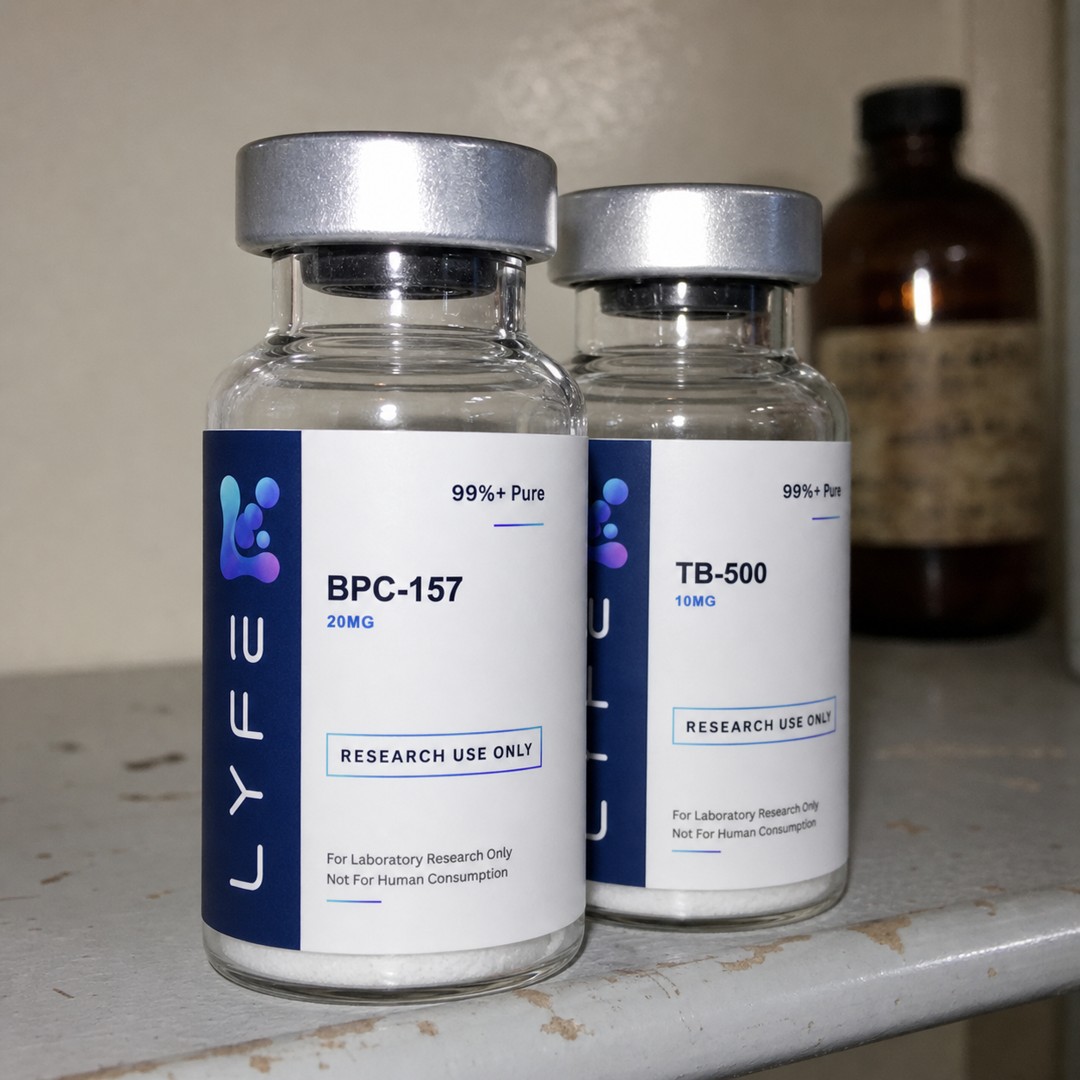
TB-500 is a synthetic version of a key active region of thymosin beta-4, a naturally occurring protein found in almost every cell type. The molecule’s best-known property is its interaction with actin, one of the main building blocks of the cellular skeleton. By binding actin, TB-500 is studied for how it affects cell migration, cell organisation and the way tissues rebuild after stress. That is why it is filed under cytoskeletal research rather than metabolism.
What MOTS-c is
MOTS-c is different in origin. It is a mitochondrial-derived peptide, meaning it is encoded inside the mitochondrial genome rather than the cell nucleus. Research interest centres on its role as a metabolic regulator: it is studied for how it interacts with cellular energy sensors, glucose handling and the pathways cells use to adapt to metabolic stress. Where TB-500 speaks the language of structure and movement, MOTS-c speaks the language of energy and metabolism.
Side-by-side comparison
| Feature | TB-500 | MOTS-c |
|---|---|---|
| Peptide family | Thymosin beta-4 fragment | Mitochondrial-derived peptide |
| Origin | Nuclear-encoded protein region | Mitochondrial genome |
| Primary research area | Cytoskeleton, cell migration, tissue remodelling | Cellular metabolism, energy signalling |
| Main molecular partner | Actin | Metabolic stress and energy-sensing pathways |
| LYFE research category | Cytoskeletal Research | Metabolic Research |
Do they overlap at all?
Only loosely. Both are peptides of interest in regeneration and recovery research in the broad sense, and both are commonly discussed alongside general questions about how cells repair and adapt. But their mechanisms do not compete: one is about the physical scaffolding of the cell and the other is about its power supply. Because they act on unrelated systems, they are studied independently far more often than they are compared head to head, and choosing between them is really a question of which research pathway you are interested in rather than which is stronger.
How to choose
If your interest is the cytoskeleton, actin dynamics or tissue remodelling models, TB-500 is the compound that maps to that work. If your interest is metabolic signalling, glucose handling or mitochondrial biology, MOTS-c is the natural fit. There is no universal winner because they are not solving the same problem. Many researchers keep both on hand precisely because they answer different questions.
Quality: what to check before you buy
With any peptide, identity and purity matter more than the label on the vial. Look for a supplier that confirms both by HPLC and mass spectrometry and can provide a certificate of analysis for the exact lot you receive. A per-lot COA is the single most useful document to ask for, because it tells you what is actually in the vial rather than what the product name implies.
Buying TB-500 and MOTS-c in Canada from LYFE Science
LYFE Science is a Canadian supplier and stocks both peptides. TB-500 lives in our Cytoskeletal Research category and MOTS-c in our Metabolic Research category. We ship coast to coast by Canada Post, with flat $25 shipping and free delivery on orders over $150. Orders paid before noon Eastern go out the same day, and most of Canada sees delivery in one to three business days. Packaging is plain and neutral, we accept Interac e-Transfer and crypto (BTC, ETH, SOL, USDC, USDT), and every lot ships with a COA. New to handling peptides? Our peptide guide covers storage and basics, and the full range is on the shop page.
Follow along
Research, lab-side
@lyfe_science →