Blog
BPC-157 vs TB-500: Recovery Peptides Compared

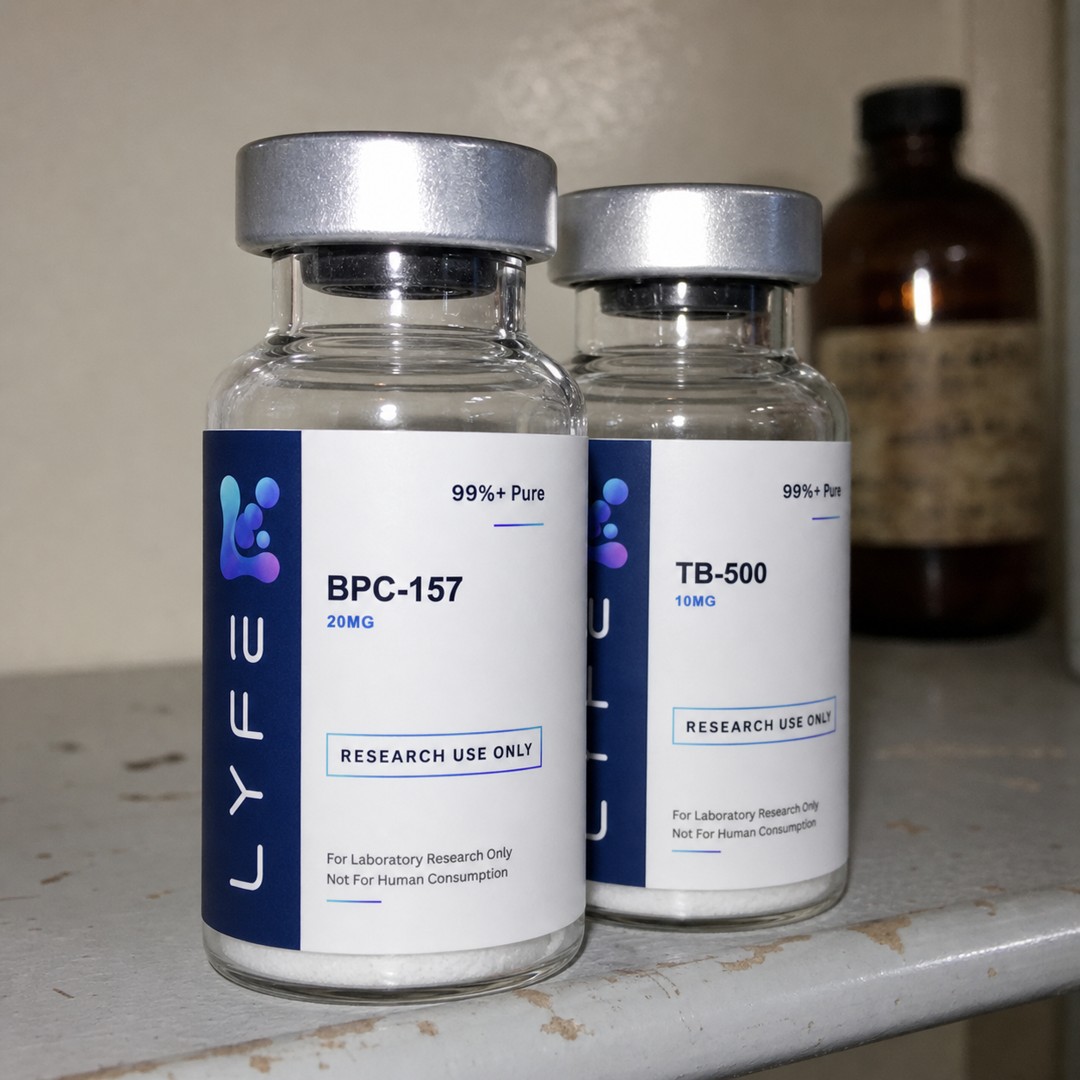
BPC-157 and TB-500 are the two peptides most often mentioned in the same breath when the topic is repair and recovery research. They are sometimes even studied together. But they are distinct molecules with different origins and different mechanisms of interest, and understanding the contrast helps clarify which fits a given line of work.
The short version
BPC-157 is a synthetic peptide derived from a protective sequence originally found in gastric juice. Its research interest sits largely in connective-tissue and gastrointestinal models.
TB-500 is a synthetic version of a region of Thymosin Beta-4, a naturally occurring protein present throughout the body. It is studied for its role in cell migration and cytoskeletal dynamics, which is why it appears so often in wound and tissue research.
Side-by-side
| Feature | BPC-157 | TB-500 |
|---|---|---|
| Origin | Sequence from gastric juice | Fragment of Thymosin Beta-4 |
| Type | Synthetic peptide | Synthetic peptide |
| Primary research angle | Connective tissue, GI models | Cell migration, cytoskeleton |
| How it is described | Localised, tissue-focused interest | Systemic, mobility-focused interest |
| Supplied as | Lyophilised powder | Lyophilised powder |
Different mechanisms of interest
The most useful way to separate the two is by what researchers are actually looking at. TB-500 is tied to actin and the cytoskeleton, the internal scaffolding that lets cells move and reorganise. That places it firmly in cell-migration and wound-model research. BPC-157 is studied more for its tissue-protective profile, particularly around connective tissue and the gut.
Because their angles differ, some research designs examine them separately and others look at them in combination, treating them as complementary rather than competing.
Handling and storage
Both peptides ship as a lyophilised powder and both benefit from the same careful handling: kept cold, dark and dry, protected from heat and light, and with freeze-thaw cycles kept to a minimum. Dry powder is the most stable form, and solutions are far more delicate and shorter-lived. Good storage is one of the simplest ways to keep either peptide performing as expected.
Choosing between them
There is no universal winner. A project focused on cell migration, the cytoskeleton or classic wound-healing models points to TB-500. A project focused on connective tissue or gastrointestinal models points to BPC-157. Many researchers are interested in both precisely because they occupy different niches.
Buying TB-500 in Canada
TB-500 is the one LYFE Science stocks, in our Cytoskeletal Research category. LYFE Science is a Canadian supplier and ships coast to coast with Canada Post. Flat $25 shipping, free over $150, in neutral packaging. Orders paid before noon ET ship the same day, and most of Canada sees delivery in 1 to 3 business days. Payment is by Interac e-Transfer or crypto (BTC, ETH, SOL, USDC, USDT). Every lot is checked by HPLC and mass spectrometry, and a certificate of analysis (COA) is available for the lot you receive.
If your work calls for BPC-157, keep an eye on the shop, as we are steadily adding to the catalogue. For TB-500, you can see the sizes we carry below.
Common questions
Are BPC-157 and TB-500 the same thing?
No. They are separate synthetic peptides with different origins. BPC-157 comes from a sequence found in gastric juice, while TB-500 is a fragment of the naturally occurring protein Thymosin Beta-4. Their research angles differ as well.
Why are they so often mentioned together?
Both are studied in repair and recovery research, so they naturally come up in the same conversations. Because their mechanisms of interest differ, some research designs look at them separately and others treat them as complementary.
Do they need the same storage?
Yes. Both arrive as a lyophilised powder and keep best when stored cold, dark and dry, away from heat and light, with freeze-thaw cycles minimised once reconstituted. A fridge suits short-term storage and a freezer suits the long term.
Follow along
Research, lab-side
@lyfe_science →