Blog
What Is Semax? Nootropic Research Peptide

Semax is a synthetic peptide that has become a fixture in neuroscience research, particularly in studies of cognition and neuroprotection. Like several other compounds in this space, it was developed in Russia and is based on a fragment of a natural hormone. That heritage is what gives it its distinctive profile as a research tool for the nervous system.
What is Semax?
Semax is a short peptide derived from a fragment of adrenocorticotropic hormone (ACTH), a natural hormone involved in the body’s stress-response system. Researchers took a small, biologically active portion of ACTH and modified it to remove the hormonal activity while keeping the effects of interest for the nervous system, then stabilised it for research use. The result is a compound studied primarily for its action in the brain rather than on the adrenal axis.
How Semax is studied
Semax is best known as a “nootropic” research peptide, meaning it is investigated in the context of cognition, learning, and memory models. A recurring theme in the literature is its relationship to neurotrophic factors, the signalling proteins that support the growth and survival of neurons. Researchers study whether Semax influences these factors, which is why it appears so often in neuroprotection research.
Research areas
- Cognition research – as a tool in learning and memory models.
- Neuroprotection – for its studied links to neurotrophic signalling and neuronal survival.
- Stress-response biology – reflecting its origin as an ACTH fragment.
- Peptide engineering – as an example of stripping the hormonal activity from a natural fragment while retaining neural effects.
The ACTH connection
Understanding Semax starts with its parent molecule. ACTH is a hormone that plays a role in the stress axis, but it also contains a small sequence with activity in the brain. By isolating and modifying that sequence, researchers created a peptide that acts on the nervous system without triggering the broader hormonal cascade. This is a classic example of how peptide science can separate one function of a molecule from another.
Semax and Selank together
Semax is frequently studied alongside Selank, a related synthetic peptide from the same research tradition. Both are examples of neuroactive peptides engineered from natural fragments, and both are commonly grouped under the nootropic label. Researchers exploring cognition and neuroprotection often encounter the two as a pair, since they are frequently compared and share a similar developmental history.
Handling and storage
Research peptides are generally supplied as a lyophilised (freeze-dried) powder, the most stable form for shipping and long-term storage. As a broad principle in the field, dry peptide is kept cool and away from light and moisture, and once reconstituted its stability window is much shorter. Keeping the certificate of analysis for each lot on file lets you match every result back to the exact material used, which underpins reproducible work. These are general handling principles rather than instructions for any particular protocol.
Sourcing research peptides in Canada
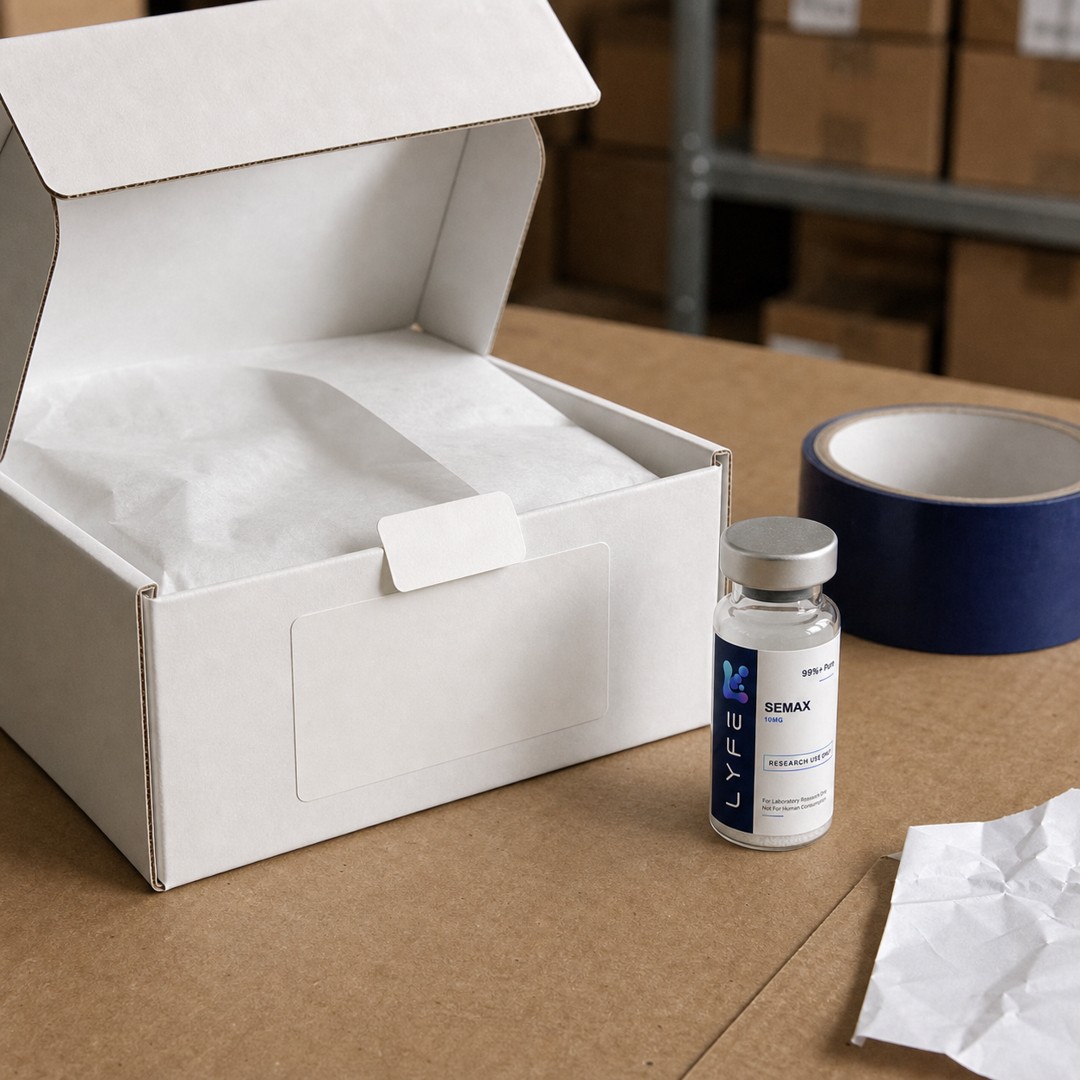
For neuroscience research, the identity and purity of your compound are non-negotiable. LYFE Science is a Canadian supplier, so orders stay inside the country and clear customs before they reach you. Every lot we carry is verified by HPLC and mass spectrometry, with a certificate of analysis available for the lot you receive. Shipping is a flat $25 across Canada by Canada Post, free over $150, in neutral packaging, with same-day dispatch on orders paid before noon ET and one to three business days to most destinations. We accept Interac e-Transfer and crypto (BTC, ETH, SOL, USDC, USDT).
Learn more
Our peptide guide is a solid starting point for anyone new to research peptides, and you can see everything we carry in the shop.
Follow along
Research, lab-side
@lyfe_science →