Blog
Complete Guide to Storing Peptides in Canada

Storage is where a lot of avoidable peptide loss happens. A high-purity vial handled poorly can degrade long before it should, while a modest vial stored well stays reliable. This complete guide walks through the full picture, from the science of what degrades a peptide to a quick-reference table you can keep on hand.
What actually breaks a peptide down
Peptides degrade through a handful of predictable pathways. Hydrolysis breaks bonds in the presence of water, oxidation attacks certain amino acids when air and light are present, and aggregation causes molecules to clump when solutions are stressed. Heat speeds all of these up. Controlling temperature, light, air and moisture is therefore the whole game.
Lyophilised powder: the stable state
Freeze-dried peptide is the form you want for storage. With almost no water present, the main degradation routes slow to a crawl. Keep sealed powder cold and dark. A fridge suits the short to medium term; a freezer is preferable for long holds. Always warm a sealed vial to room temperature before opening so that condensation does not form on the cold glass and contaminate the powder with moisture.
Reconstituted solution: the fragile state
Adding liquid changes everything. In solution a peptide is exposed to water and dissolved oxygen, so its usable life shrinks from months to a much shorter window. Refrigerate solutions, shield them from light, keep them in a stable cold spot, and never leave them warm. Cleanliness matters because a contaminated solution can spoil regardless of how good the peptide was.
Shelf life at a glance
| State | Best storage | Relative stability |
|---|---|---|
| Sealed lyophilised powder | Freezer, dark, dry | Longest |
| Sealed lyophilised powder | Refrigerator, dark | Long |
| Reconstituted solution | Refrigerator, dark, stable spot | Short |
| Any state | Warm, lit, humid | Poor |
Temperature: how cold is cold enough
The general principle is simple: colder is more stable, and steadier is better than colder-but-fluctuating. For short to medium holds of sealed powder, a normal refrigerator is adequate. For long-term storage, a freezer slows degradation further. The mistake to avoid is not the exact temperature but the swing between them, since each cycle of warming and cooling stresses the molecule. Pick one storage location and leave the vial there rather than moving it around.
Signs a peptide may have degraded
Degradation is often invisible, but a few clues are worth watching for. Powder that has clumped, changed colour, or taken on an oily sheen has likely been exposed to moisture or heat. A reconstituted solution that has turned cloudy or thrown a visible particulate is no longer clean. None of these are definitive on their own, but any of them is a reason to be cautious and to lean on your documentation rather than the vial’s appearance alone.
Practical habits that pay off
- Store vials in their original packaging to keep light out.
- Minimise temperature swings; steady cold beats frequent handling.
- Avoid repeated freeze-thaw cycles on the same vial.
- Label with the lot number and arrival date for easy tracking.
- Keep a desiccant with any powder briefly kept outside the fridge.
It starts with careful shipping
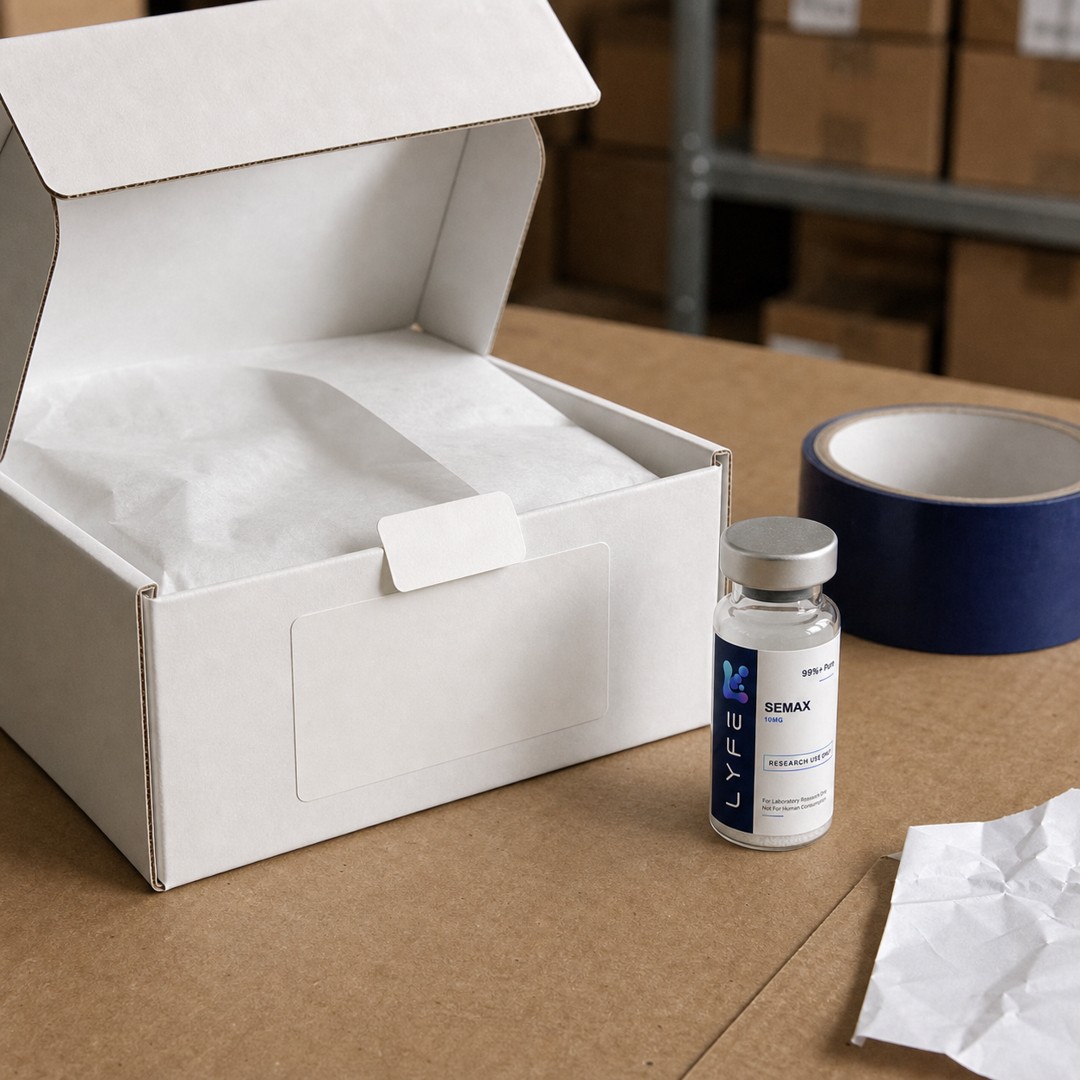
Even perfect storage cannot undo damage done in transit, so a supplier who dispatches quickly matters. LYFE Science is a Canadian supplier that ships coast to coast with Canada Post. Shipping is a flat $25 and free on orders over $150, dispatched the same day when payment clears before noon Eastern and arriving in one to three business days across most of the country. Packaging is plain and unbranded. Payment is by Interac e-Transfer or crypto (BTC, ETH, SOL, USDC, USDT). Short Canadian transit times get your vials into cold storage sooner, and every lot is verified by HPLC and mass spectrometry with a COA available so you know what you started with.
Follow along
Research, lab-side
@lyfe_science →