Blog
What Is Selank? A Research Overview

Selank is a synthetic peptide that shows up frequently in neuroscience and behavioural research. It was developed in Russia and is derived from a naturally occurring immune peptide, which gives it an interesting dual identity: part immune-signalling molecule, part nervous-system research tool. That combination is why it appears across several different fields of study.
What is Selank?
Selank is a short, synthetic peptide based on a natural fragment called tuftsin, a small immune-modulating peptide the body produces on its own. Researchers took that fragment and modified it to improve its stability, producing Selank. The result is a compound that keeps some of tuftsin’s biology while being more durable and easier to work with in a research setting.
How Selank is studied
Most of the interest in Selank comes from neuroscience. It is investigated for the way it may influence signalling molecules in the brain, and it is often grouped with other “nootropic” research peptides, compounds studied in the context of cognition, memory, and stress response. Because it originates from an immune peptide, it is also studied for the overlap between the immune system and the nervous system, an area sometimes called neuroimmunology.
Research areas
- Neuropharmacology – as a tool for studying brain signalling and behavioural models.
- Stress-response research – it is frequently examined in models of anxiety-like behaviour.
- Neuroimmunology – reflecting its origin as a modified immune peptide.
- Peptide stability – as an example of how modifying a natural fragment can extend its usable life.
Selank and the tuftsin connection
The link to tuftsin is central to understanding Selank. Tuftsin is a naturally occurring peptide involved in immune signalling, and it is short-lived in the body. By adjusting its structure, researchers created a more stable analogue that retains research value. This is a common strategy in peptide science: start with a natural molecule, then engineer a version that is easier to study.
Selank alongside Semax
Selank is often mentioned in the same breath as Semax, another synthetic peptide from the same research tradition. Both are studied in the context of neuroscience and both are examples of peptides engineered from natural fragments. Researchers building a background in nootropic peptides usually encounter the two together, since they share a similar origin story and are often compared side by side.
Handling and storage
Research peptides are generally supplied as a lyophilised (freeze-dried) powder, the most stable form for transport and storage. As a broad principle in the field, dry peptide is kept cool and protected from light and moisture, and once brought into solution its usable window shortens considerably. Retaining the certificate of analysis for each lot lets you tie your work back to the exact material handled, which is central to reproducible research. These are general handling principles, not instructions for any specific protocol.
Sourcing research peptides in Canada
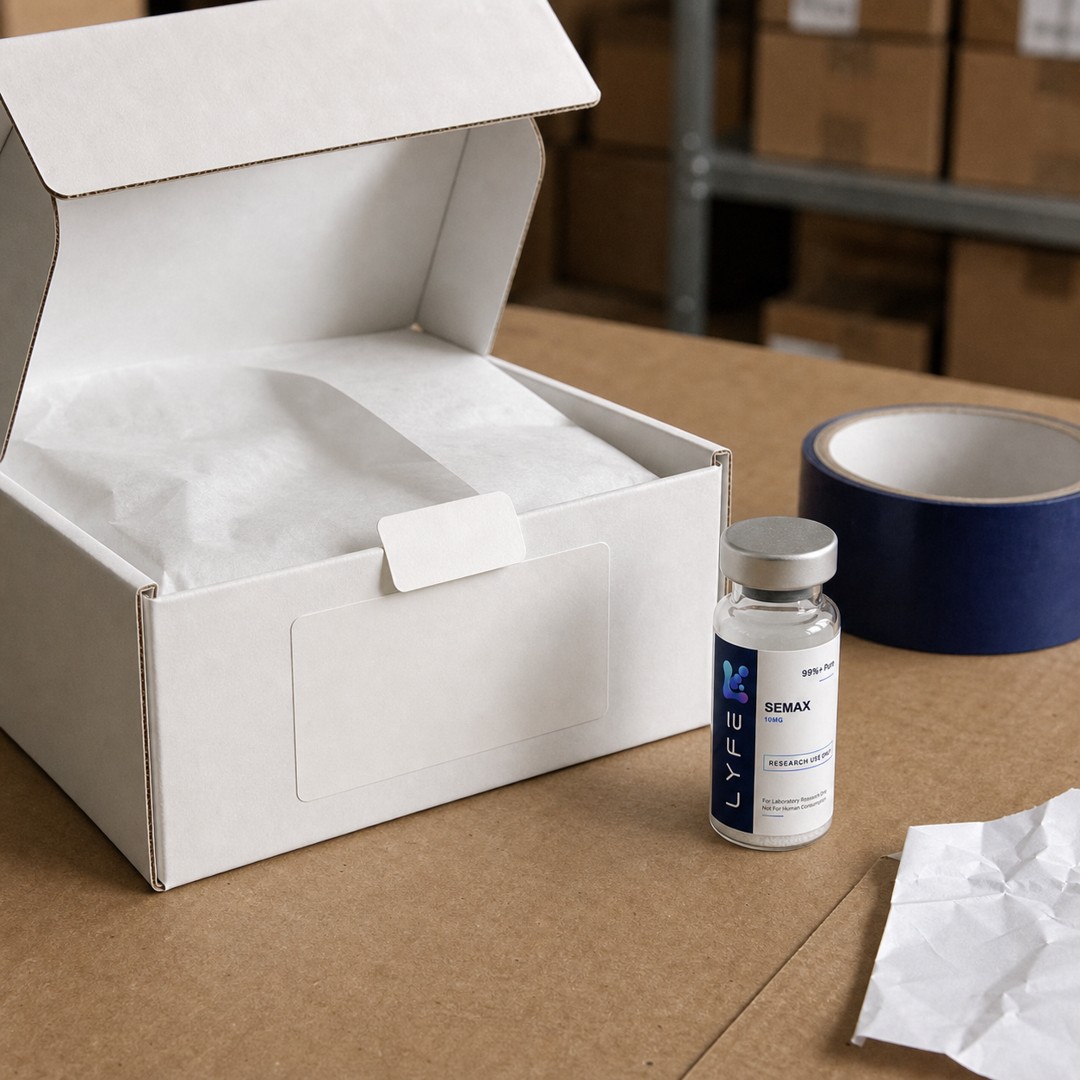
For neuroscience work as with any field, the reliability of your compound matters. LYFE Science is a Canadian supplier, so orders stay in the country and clear customs before reaching you. Every lot we carry is verified by HPLC and mass spectrometry, with a certificate of analysis available per lot so you can confirm identity and purity. Shipping is a flat $25 across Canada by Canada Post, free over $150, in neutral packaging, with same-day dispatch on orders paid before noon ET and one to three business days to most destinations. Payment is by Interac e-Transfer or crypto (BTC, ETH, SOL, USDC, USDT).
Learn more
If you are new to research peptides, our peptide guide explains how these compounds are stored, handled, and verified. Browse the full catalogue in the shop.
Follow along
Research, lab-side
@lyfe_science →