Blog
AOD-9604 Peptide: A Research Guide for Canada

AOD-9604 is one of the more talked-about peptides in metabolic research, and for good reason. It is a small, targeted fragment derived from the human growth hormone (hGH) molecule, engineered to isolate a single region of interest while leaving the rest of the parent hormone behind. For researchers comparing metabolic peptides, understanding exactly what AOD-9604 is (and is not) makes it easier to design clean, meaningful studies.
What is AOD-9604?
The name is shorthand for “Anti-Obesity Drug, fragment 9604.” Structurally, AOD-9604 corresponds to the C-terminal region of human growth hormone, specifically amino acids 176 to 191, with a small modification added for stability. This terminal fragment is the part of the hGH molecule that early research associated with lipolytic (fat-metabolising) activity, while it does not carry the full growth-signalling portion of the parent hormone.
In practical terms, that means AOD-9604 was designed to explore one narrow question from the much larger biology of growth hormone. It is a synthetic peptide, produced to a defined sequence, rather than an extract of anything biological.
Origin and development
AOD-9604 grew out of academic work at an Australian university that mapped which segments of growth hormone drove which effects. The goal was to separate the metabolic activity of hGH from its broader systemic actions, producing a much smaller molecule that could be studied on its own. That lineage is why AOD-9604 is often grouped with the “growth hormone fragment” family in reference material.
Why researchers study it
AOD-9604 sits squarely in the metabolic-research category. The studies most often cited around it look at:
- Lipid metabolism – how the fragment interacts with fat-cell (adipocyte) pathways in laboratory models.
- Selectivity – whether isolating the C-terminal region avoids the wider signalling attributed to full-length growth hormone.
- Comparative pharmacology – how a short fragment behaves next to intact hormones and other metabolic peptides.
Because it is a defined, single-sequence molecule, AOD-9604 is a useful reference point when researchers want to study a narrow slice of hormone biology without the confounding effects of a larger protein.
How AOD-9604 compares to related peptides
| Peptide | Type | Primary research focus |
|---|---|---|
| AOD-9604 | hGH fragment (176-191) | Lipid/metabolic pathways |
| Full-length hGH | Complete hormone | Broad growth signalling |
| MOTS-c | Mitochondrial peptide | Energy and metabolic regulation |
| CJC-1295 / Ipamorelin | Secretagogues | Growth-hormone signalling axis |
This is why AOD-9604 is frequently discussed alongside the broader metabolic and signalling peptide categories: it lets a study team compare a hormone fragment against secretagogues and mitochondrial peptides that approach metabolism from entirely different directions.
Quality and handling considerations
With any research peptide, the sequence is only half the story. Purity and identity are what let one lot be compared to another. That is why every peptide worth studying should arrive with a certificate of analysis (COA) for its specific lot, backed by analytical testing such as HPLC and mass spectrometry. AOD-9604 is a small molecule, so lot-to-lot consistency and correct storage matter for reproducible work.
Buying AOD-9604 in Canada
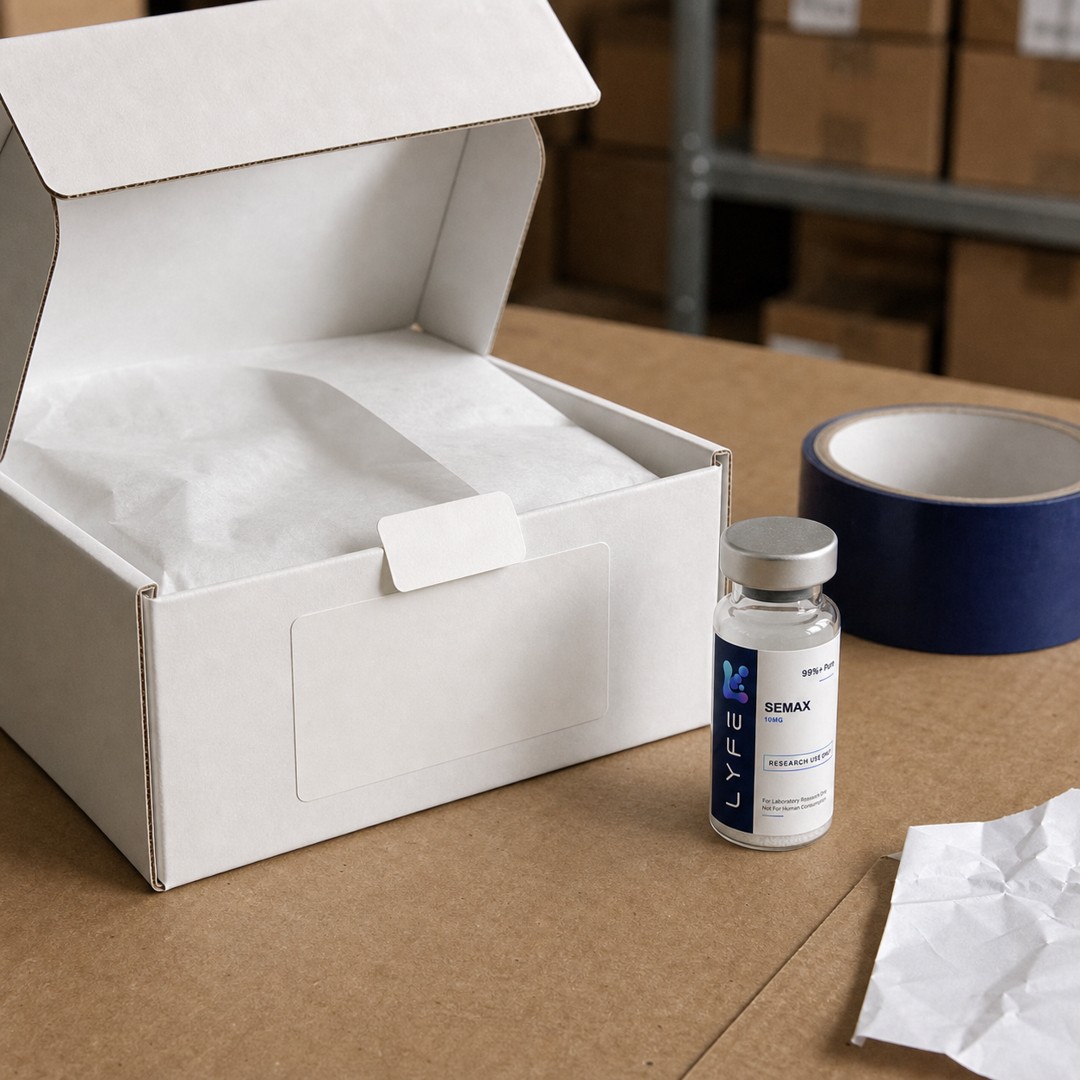
Sourcing research peptides domestically saves time and avoids customs delays. LYFE Science is a Canadian supplier shipping Canada-wide by Canada Post, with flat $25 shipping and free delivery over $150. Orders paid before noon ET dispatch the same day, and most of Canada receives parcels in 1 to 3 business days in plain, neutral packaging. Payment is by Interac e-Transfer or crypto (BTC, ETH, SOL, USDC, USDT).
AOD-9604 is available at LYFE Science, alongside our wider metabolic and signalling research lines, and every lot ships with its own COA. See what is in stock in our shop and read more profiles like this one in our peptide guide.
Follow along
Research, lab-side
@lyfe_science →