Blog
Peptide Stacking: Combining Peptides Guide

Peptide stacking is one of those phrases that gets used constantly but rarely explained clearly. At its simplest, stacking means using more than one peptide together rather than in isolation. This guide explains what stacking actually is, why researchers do it, the logic behind common pairings, and what to keep in mind when sourcing the compounds involved.
What stacking means
A stack is any combination of two or more peptides studied together. The idea is not simply to pile on more molecules, but to combine compounds that act on different pathways so their effects complement rather than duplicate one another. A well-designed stack is greater than the sum of its parts because each peptide contributes something the others do not.
Why combine peptides at all?
Biological systems rarely run on a single switch. A given outcome is usually the product of several signals working together, so a single peptide often reaches a natural ceiling on its own. Combining peptides that act on separate receptors or pathways lets researchers approach a process from more than one angle at once. The keyword is complementary: the best stacks pair molecules with different mechanisms, not two that do the same job.
A classic example
The most familiar stack is a GHRH analogue paired with a growth hormone releasing peptide, for instance CJC-1295 (No DAC) combined with Ipamorelin. One raises the amount of growth hormone available to be released while the other opens the gate and eases the brake that normally limits release. Acting on two different receptors, they are described as synergistic, and the pair is so standard that it is often sold as a single blended vial rather than two separate products.
Principles of a sensible stack
- Different pathways. Combine compounds with distinct mechanisms so they complement rather than overlap.
- Start simple. A clean two-peptide pairing is easier to interpret than a crowded stack of five.
- One variable at a time. Adding several new compounds at once makes it impossible to attribute any result.
- Known quantities. Every compound in a stack should be well characterised and documented.
Other pairings researchers explore
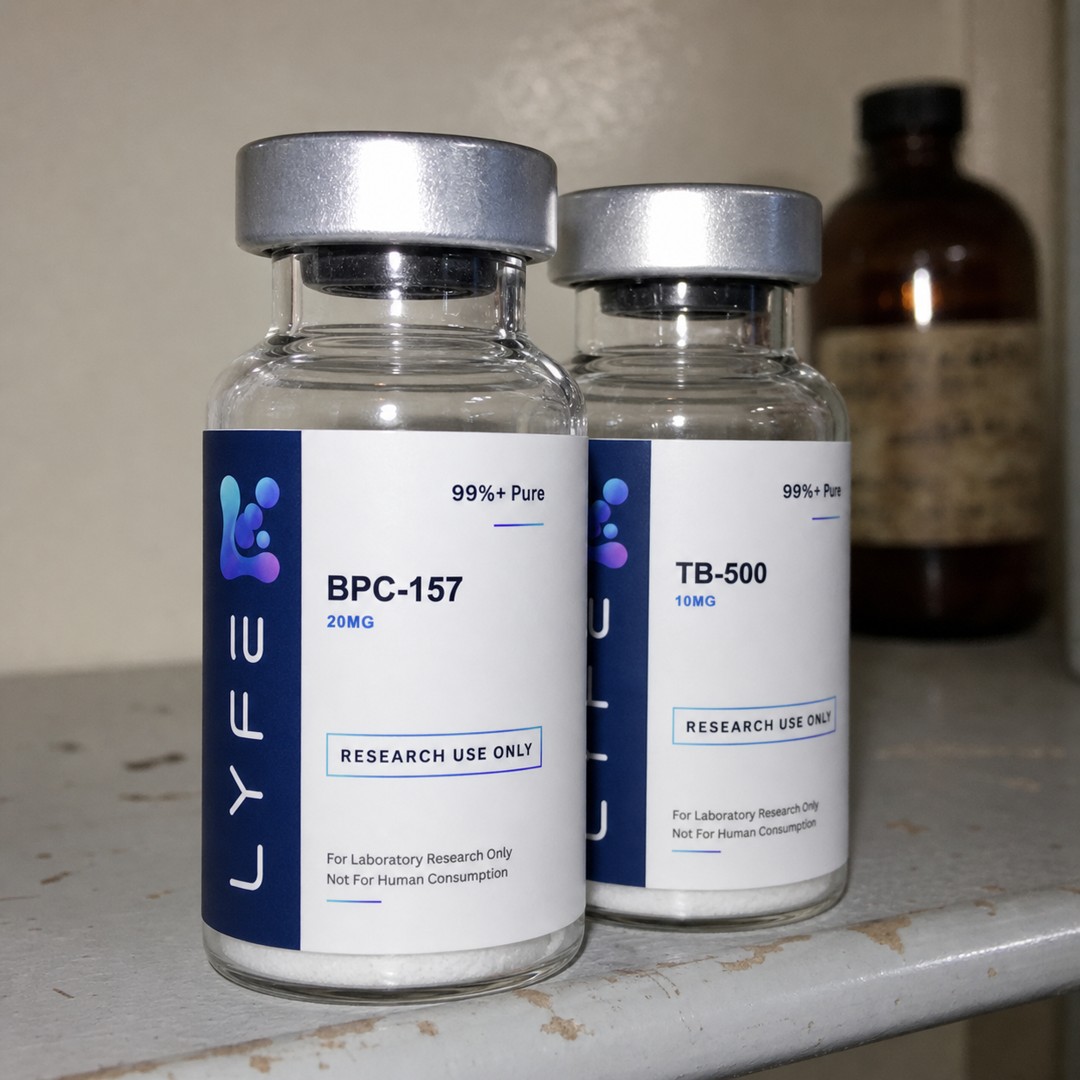
The growth hormone pair is the best known, but the same complementary logic appears elsewhere. Repair-oriented work often looks at cytoskeletal peptides such as TB-500 alongside other regenerative compounds, while metabolic research may combine a mitochondrial peptide such as MOTS-c with compounds acting on separate energy pathways. Copper peptides like GHK-Cu are studied both alone and as part of broader matrix-focused combinations. In every case the guiding question is the same: do these two molecules do different jobs, and does combining them tell you something neither could alone?
Why quality matters more in a stack
A stack is only as reliable as its weakest component. If one peptide in a combination is impure or mislabelled, it contaminates the entire result and you cannot tell which molecule did what. That is why identity and purity confirmed by HPLC and mass spectrometry, with a per-lot certificate of analysis, matter even more when you are combining compounds than when you use one alone. Storage matters too: a stack built from one fresh vial and one degraded one is not the stack you think you have, so handling each component correctly is part of running a clean combination.
Sourcing your stack in Canada
LYFE Science stocks the building blocks of the most common stacks, including the CJC-1295 (No DAC) and Ipamorelin blend, organised by research domain so related compounds are easy to find together. We are a Canadian supplier shipping nationwide by Canada Post at a flat $25, free over $150, with same-day dispatch on orders paid before noon Eastern and one to three business days to most of the country. Packaging is neutral, payment is by Interac e-Transfer or crypto (BTC, ETH, SOL, USDC, USDT), and every lot ships with a COA. The peptide guide covers handling, and the shop page has the full range.
Follow along
Research, lab-side
@lyfe_science →