Blog
Peptide Cold Chain Shipping in Canada

Research peptides are delicate cargo. Many are supplied as a freeze-dried powder that is stable when kept cool and dry, but exposure to heat and moisture over a long transit can degrade a compound before it ever reaches the lab bench. That is why cold-chain shipping, and specifically domestic Canadian shipping, matters when you buy research compounds. This guide explains how peptides travel, what can go wrong, and why a short domestic route beats a long international one.
Why peptides are temperature-sensitive
Peptides are chains of amino acids, and their integrity depends on those chains staying intact. Heat accelerates chemical breakdown, and moisture can trigger degradation in a hygroscopic powder. In their lyophilised (freeze-dried) form peptides are far more robust than in solution, which is why they are shipped dry, but robust is not the same as indestructible. Prolonged warmth still works against them.
What cold-chain shipping means in practice
Cold-chain shipping is the practice of keeping a temperature-sensitive product within an acceptable range from dispatch to delivery. For lyophilised peptides moving domestically, that usually means insulated packaging and, where appropriate, a cold pack, combined with the most important factor of all: minimising the time the parcel spends in transit. The shorter the journey, the less any packaging has to compensate for.
Why domestic Canadian shipping is the quiet advantage
A peptide shipped from within Canada to a Canadian address travels a fraction of the distance of one crossing a border. That single fact removes a stack of risks at once:
- No customs holds. An international parcel can sit at a border facility for days, often at uncontrolled temperatures.
- Fewer handoffs. Every transfer between carriers is a chance for a package to sit on a warm dock.
- Shorter time in transit. Less time in transit simply means less cumulative heat and moisture exposure.
- Predictable timelines. A domestic route is easier to plan around, so cold packs are still cold on arrival.
For temperature-sensitive compounds, geography is not a minor detail. A domestic supplier is one of the most effective forms of cold-chain protection there is.
How LYFE Science ships
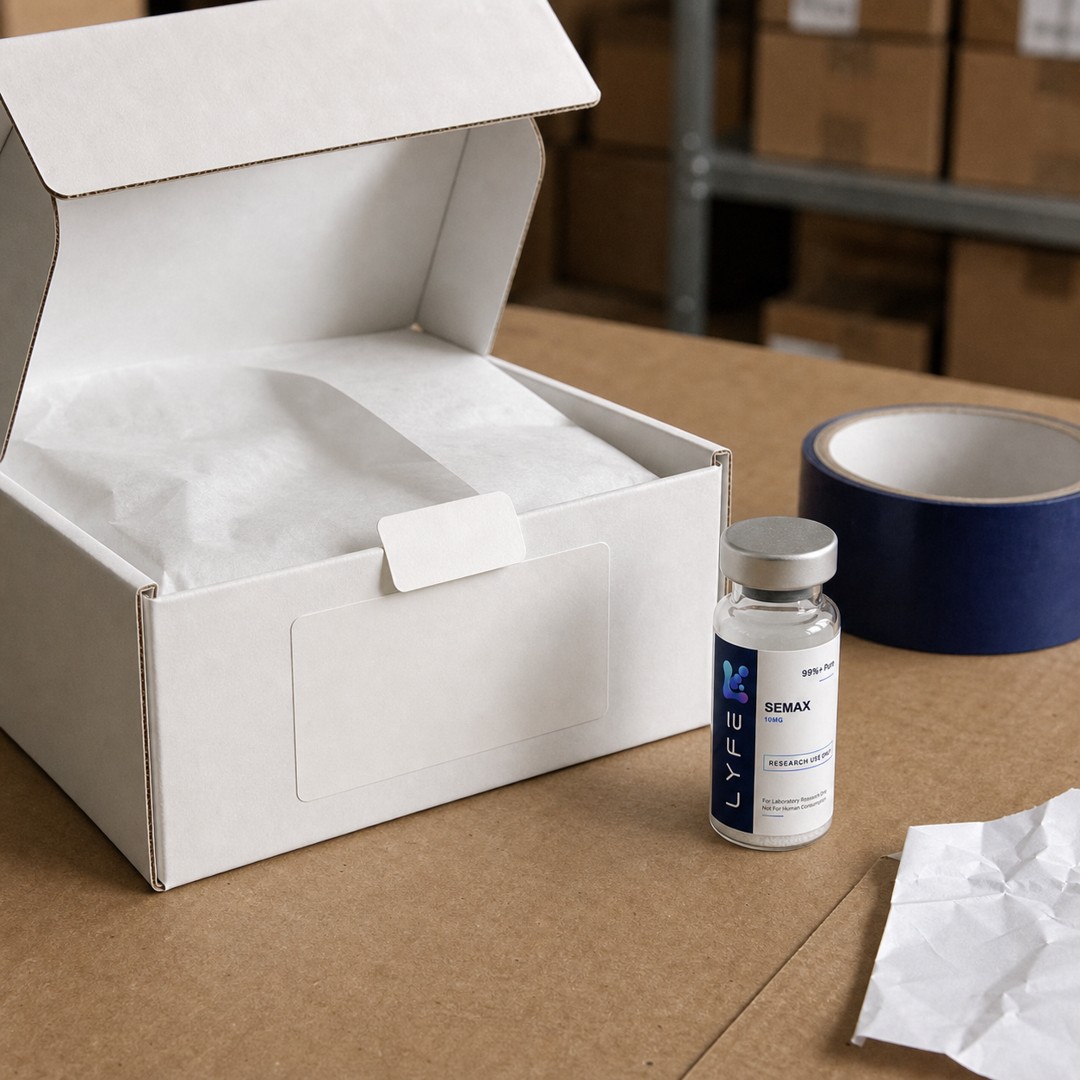
LYFE Science is a Canadian supplier and ships Canada-wide by Canada Post. Orders paid before noon Eastern go out the same day, and most of Canada is reached in one to three business days, which keeps parcels moving quickly and limits transit exposure. Shipping is a flat $25 and free over $150, in neutral packaging. Payment is by Interac e-Transfer or crypto (BTC, ETH, SOL, USDC, USDT).
Powder versus solution
One reason peptides survive shipping as well as they do is that they travel dry. A lyophilised powder has had its water removed, which slows the chemical reactions that break peptides down and makes the compound far more tolerant of time and temperature than the same peptide dissolved in liquid. This is why shipping a reconstituted solution is rarely done, and why the cold-chain conversation focuses on keeping the powder dry and reasonably cool rather than frozen solid. Understanding that distinction helps explain why a well-handled domestic parcel arrives in good shape even without elaborate refrigeration.
What you can do on your end
- Order to an address where the parcel will not sit outside for hours after delivery.
- Bring peptides indoors promptly and store them cold as soon as they arrive.
- Plan orders around your schedule so a package is not waiting through a weekend.
The bottom line
Cold-chain integrity is a shared responsibility between supplier and recipient, but the biggest lever is distance. Buying from a Canadian source shortens the journey, avoids customs, and keeps your compounds closer to the condition they left in. Combined with per-lot HPLC and mass-spectrometry verification, domestic shipping is a straightforward way to protect what you pay for.
Learn more in our research compound guide, or browse current stock in the LYFE Science shop.
Follow along
Research, lab-side
@lyfe_science →