Blog
MOTS-c vs GHK-Cu vs BPC-157: Longevity Guide

MOTS-c, GHK-Cu, and BPC-157 are three of the most searched peptides in longevity and repair research, and they are frequently discussed together. But they operate on completely different levels of biology: cellular energy metabolism, extracellular matrix remodelling, and tissue-protective signalling. Understanding how they differ is the fastest way to decide which one your research question actually needs.
At a glance
| Peptide | Primary domain | Signature mechanism |
|---|---|---|
| MOTS-c | Metabolic research | AMPK activation, insulin sensitivity, mitochondrial signalling |
| GHK-Cu | Matrix & copper research | Copper delivery, gene expression, extracellular matrix remodelling |
| BPC-157 | Tissue and gut research | Angiogenesis and cytoprotection signalling |
MOTS-c: the metabolic angle on ageing
MOTS-c is a mitochondrial-derived peptide encoded within the mitochondrial genome. Its longevity relevance is metabolic: research links it to AMPK activation, improved insulin sensitivity, and glucose uptake in skeletal muscle, and it has been observed moving to the nucleus under stress to influence protective gene expression. If your framework treats ageing as a decline in metabolic flexibility and mitochondrial function, MOTS-c is the natural probe.
GHK-Cu: matrix remodelling and copper biology
GHK-Cu is a copper-binding tripeptide (glycyl-L-histidyl-L-lysine) that naturally complexes with copper ions. Its research reputation centres on the extracellular matrix: it has been studied for influence on the expression of collagen and other matrix components, and for its role as a copper carrier, since copper is a cofactor in numerous remodelling enzymes. GHK-Cu levels in the body decline with age, which is part of why it draws longevity attention. Where MOTS-c is about energy, GHK-Cu is about the structural and regenerative environment around cells.
BPC-157: tissue-protective signalling
BPC-157 is a synthetic peptide derived from a sequence identified in gastric juice. Research has focused on its association with angiogenesis (new blood-vessel formation) and cytoprotection, particularly in models of connective tissue and gastrointestinal integrity. It is studied less as an ageing compound per se and more as a repair-signalling molecule, though repair capacity and healthspan are closely linked concepts.
How to choose
- Studying metabolism, glucose, or mitochondria? MOTS-c.
- Studying skin, collagen, matrix, or copper-dependent remodelling? GHK-Cu.
- Studying tissue repair, angiogenesis, or gut models? BPC-157.
They are complementary rather than competing. A researcher building a broad healthspan program might touch all three, because each addresses a different hallmark of ageing: energy metabolism, extracellular matrix decline, and repair signalling.
Why they get grouped together anyway
If these three peptides work on such different systems, why are they constantly listed side by side? Partly it is search behaviour: they are the peptides people encounter first when they start reading about “longevity peptides,” so they end up compared even though a metabolic signal, a matrix tripeptide, and a repair peptide are not really rivals. Partly it is the healthspan framing: modern ageing research treats decline as multi-system, so a program interested in extending healthy function naturally wants a tool for each system. Seen that way, MOTS-c, GHK-Cu, and BPC-157 are less a shortlist to choose from and more a toolkit, with each addressing a layer the others leave untouched.
A quick decision path
- Start with the readout. Ask what you are actually measuring: glucose and mitochondrial output point to MOTS-c, collagen and matrix markers point to GHK-Cu, vascularisation and tissue integrity point to BPC-157.
- Match the model system. Muscle and metabolic tissue favour MOTS-c; skin, connective tissue, and dermal models favour GHK-Cu; gut and tendon models favour BPC-157.
- Consider availability. MOTS-c and GHK-Cu are stocked in Canada by LYFE Science with per-lot documentation, which simplifies a project that needs consistent, traceable material.
Sourcing these peptides in Canada
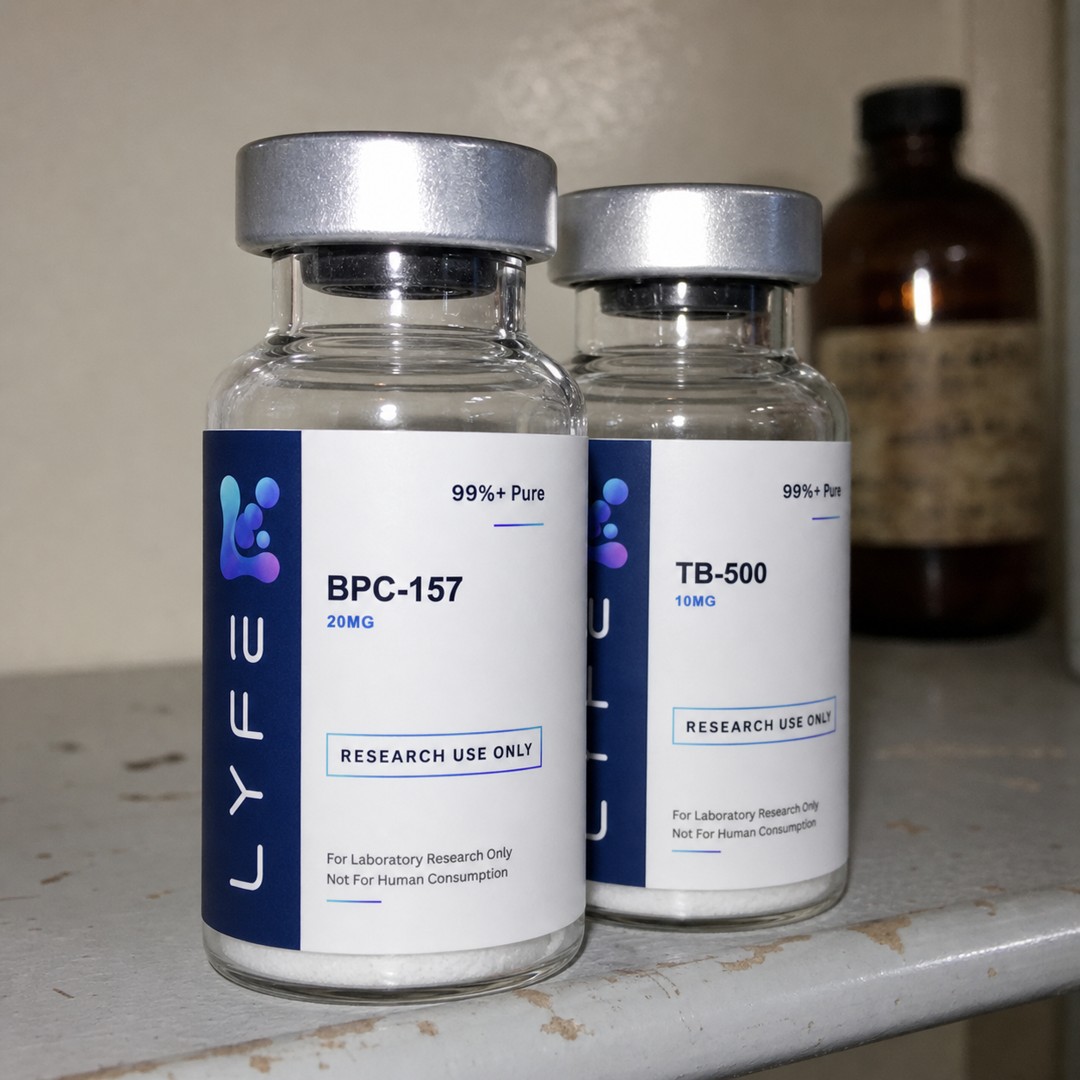
Two of these three are in the LYFE Science catalogue. MOTS-c sits in our metabolic research category and GHK-Cu in our matrix and copper research category, both with purity verified by HPLC and identity confirmed by mass spectrometry, and a COA available per lot. BPC-157 is not currently part of the LYFE range; you can browse what we carry in the shop.
We are a Canadian supplier shipping Canada-wide by Canada Post, flat $25 and free over $150, in neutral packaging, with same-day dispatch on orders paid before noon ET. Payment is by Interac e-Transfer or crypto (BTC, ETH, SOL, USDC, USDT). For terminology and handling basics across all three peptides, the peptide guide is a good starting point.
Follow along
Research, lab-side
@lyfe_science →