Blog
GLOW vs KLOW Peptide Blends Compared

GLOW and KLOW are two of the most talked-about multi-peptide research blends, and they are easy to confuse because they share most of the same ingredients. This guide lays out exactly what is in each formula, what the extra component in KLOW changes, and how to think about the two side by side.
What GLOW and KLOW actually are
Both are pre-combined blends rather than single compounds. Instead of pairing peptides yourself, you get a fixed ratio in one vial. The naming is a simple shorthand for the peptides inside:
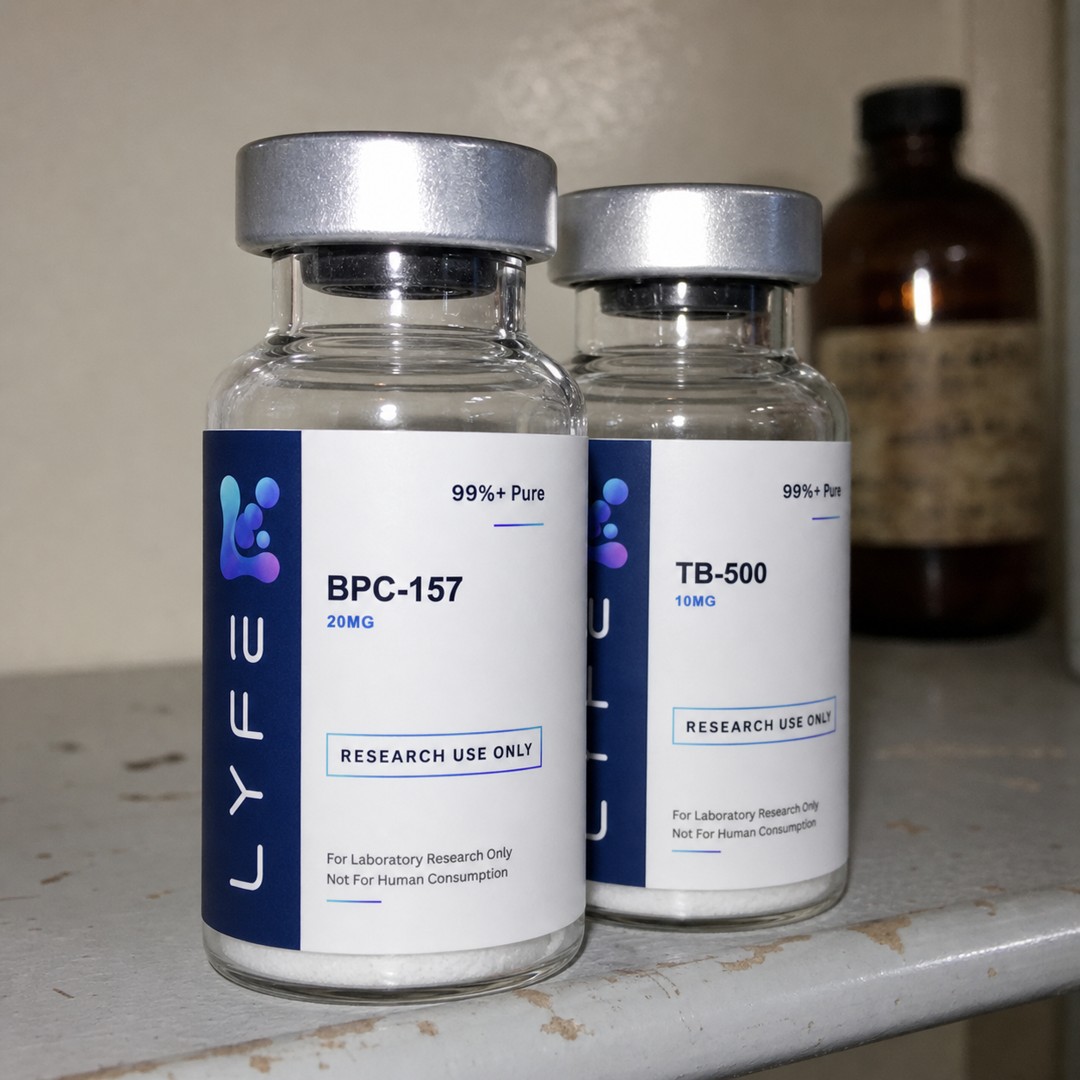
- GLOW combines GHK-Cu, BPC-157 and TB-500.
- KLOW is the same three peptides plus KPV. The leading K is the tell: it is GLOW with KPV added.
So the entire practical difference between the two blends comes down to one question: do you want KPV in the mix or not?
The shared backbone: GHK-Cu, BPC-157, TB-500
GHK-Cu
GHK-Cu is a copper-binding tripeptide (glycyl-L-histidyl-L-lysine complexed with copper). It is one of the most heavily studied peptides in the skin and connective-tissue literature, where interest centres on extracellular matrix signalling, collagen-related pathways and its role as a copper carrier.
BPC-157
BPC-157 is a synthetic 15-amino-acid sequence derived from a protein found in gastric juice. Research attention focuses on tissue-repair and angiogenesis models, which is why it is a common inclusion in recovery-oriented blends.
TB-500
TB-500 is a synthetic fragment related to thymosin beta-4. Studies have looked at actin regulation, cell migration and wound-healing models. It rounds out the recovery theme that all three shared peptides have in common.
What KPV adds in KLOW
KPV is a short tripeptide (lysine-proline-valine) corresponding to the C-terminal fragment of alpha-melanocyte-stimulating hormone (alpha-MSH). The research literature around KPV is oriented toward inflammatory-pathway and gut-model work rather than structural tissue repair. Adding it is what shifts KLOW from a three-peptide recovery-and-skin blend toward a four-peptide formula with an additional inflammation-research angle.
GLOW vs KLOW at a glance
| Property | GLOW | KLOW |
|---|---|---|
| Peptides | GHK-Cu, BPC-157, TB-500 | GHK-Cu, BPC-157, TB-500, KPV |
| Component count | 3 | 4 |
| Extra vs the other | Simpler, fewer variables | Adds KPV |
| Research themes | Skin, matrix, recovery | Skin, matrix, recovery, inflammation |
| Copper peptide included | Yes (GHK-Cu) | Yes (GHK-Cu) |
How to choose between them
From a research-design point of view, GLOW is the cleaner starting point: three peptides means fewer overlapping variables, which makes it easier to attribute an observation to a specific component. KLOW is the pick when the fourth pathway that KPV brings is part of what you want to look at. Neither is a strict upgrade of the other; they are different tools with a large overlap.
One practical note on blends generally: because the ratio is fixed, you trade flexibility for convenience. If you want to vary one peptide independently, buying the components separately gives you more control. If you want a single, consistent, pre-mixed vial, a blend removes the guesswork.
Blends vs single peptides
There is a genuine trade-off here. A blend is convenient and keeps the ratio identical every time, which is helpful for consistency across a body of work. The downside is that if you observe something interesting, you cannot easily tell which of the three or four peptides is responsible, because they all change together. Buying GHK-Cu, BPC-157 and TB-500 as separate vials lets you isolate one variable at a time, at the cost of more preparation and record-keeping. Many people start with individual components to understand each peptide, then move to a blend once they know how the pieces behave.
New to any of these terms? Our peptide guide explains fragments, tripeptides, copper complexes and reconstitution in plain language.
Sourcing these peptides in Canada
LYFE Science is a Canadian supplier shipping nationwide by Canada Post, with flat $25 shipping and free delivery over $150. Orders paid before noon ET dispatch the same day and reach most of Canada in 1 to 3 business days, in neutral packaging. Every lot is verified by HPLC and mass spectrometry, with a COA available per lot. We accept Interac e-Transfer and crypto (BTC, ETH, SOL, USDC, USDT).
We carry individual components such as GHK-Cu and TB-500, and the full catalogue is below.
Follow along
Research, lab-side
@lyfe_science →