Blog
GLOW Blend Composition: GHK-Cu, BPC-157, TB-500

The GLOW blend is one of the most searched peptide combinations online, yet its composition is often described loosely. This guide breaks down exactly what the blend usually contains, what each of the three peptides is studied for, and why many researchers prefer to work with the components individually.
The three components
GLOW is not a single molecule. It is a name for a mixture of three separate peptides:
- GHK-Cu, the copper-bound tripeptide glycyl-L-histidyl-L-lysine. It is the compound most associated with matrix, copper-delivery and tissue-remodelling research.
- BPC-157, a synthetic peptide fragment derived from a protein found in gastric juice. It is studied mainly in gastrointestinal and connective-tissue models.
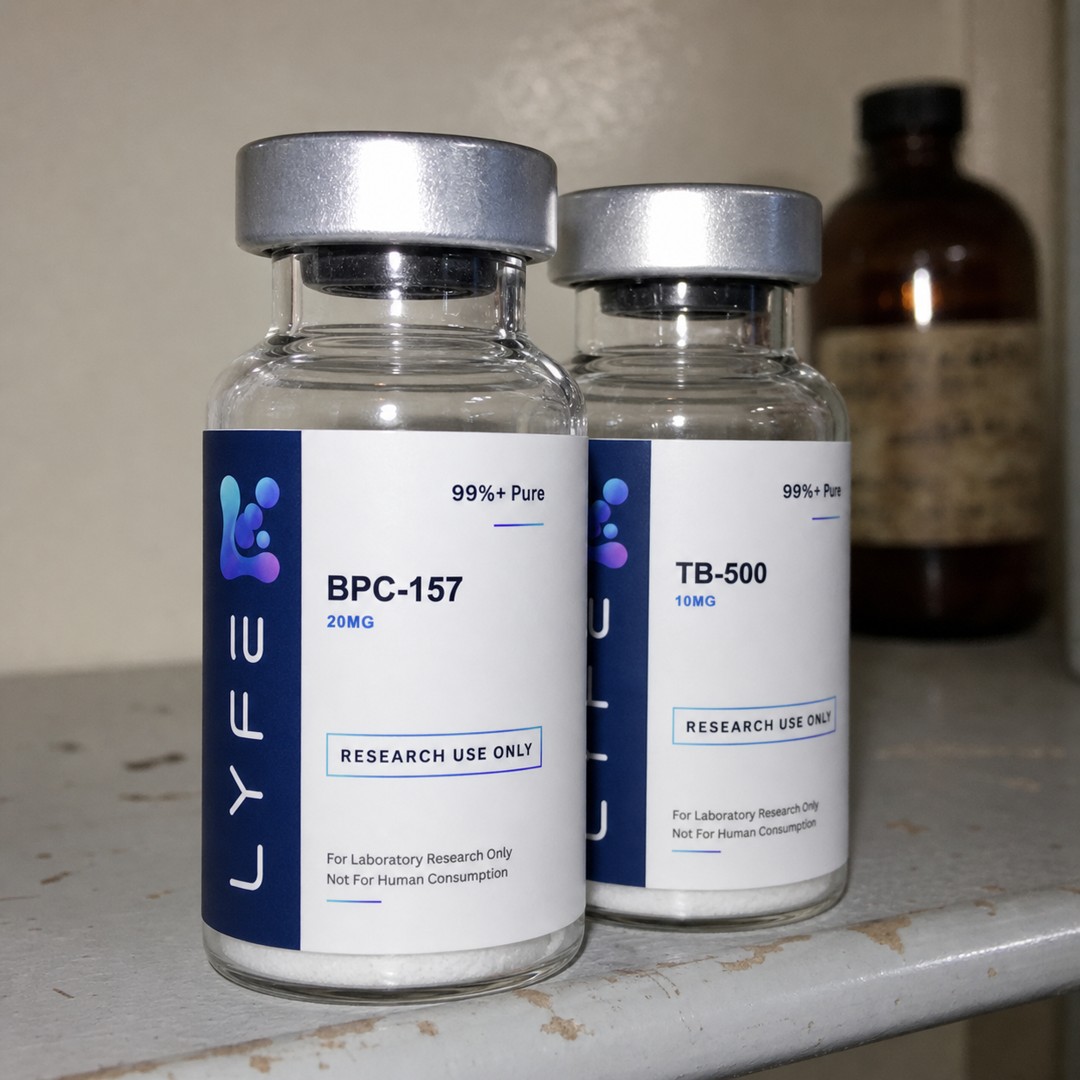
- TB-500, a synthetic fragment related to the protein thymosin beta-4. It appears in cytoskeletal and tissue-context research.
Why these three are grouped
The logic behind the grouping is that each peptide is associated with a different arm of tissue and repair biology, so combining them is meant to touch several pathways at once. That breadth is the appeal of the blend for exploratory, screening-style work.
| Peptide | Type | Common research context |
|---|---|---|
| GHK-Cu | Copper tripeptide | Matrix, copper delivery, remodelling |
| BPC-157 | Synthetic peptide fragment | GI and connective-tissue models |
| TB-500 | Thymosin beta-4 fragment | Cytoskeletal and tissue research |
The catch with a pre-mixed blend
Grouping three actives into one vial creates real analytical problems. You now have to confirm the identity and purity of each of the three peptides, and the ratio between them, before you can trust anything you measure. If a result appears, a blend cannot tell you which of the three drove it, or whether they interacted. And a single certificate of analysis for a mixture is far weaker than a clean COA for each defined molecule.
For that reason, many researchers buy the components separately and combine them deliberately, keeping full control over identity and ratio. Two of the three, GHK-Cu and TB-500, are stocked as individually characterised products; BPC-157 is a separate compound with its own literature.
Verifying a blend, component by component
If you do choose to work with a pre-mixed product, hold it to the same standard as any other material. Each of the three peptides should have a confirmed identity by mass spectrometry and a stated purity by HPLC, and the blend should declare the ratio of the components. Anything less and you are running experiments on an undefined input. The reason single peptides are easier to trust is not that they are inherently better molecules; it is that a defined, one-compound certificate of analysis leaves far less room for ambiguity.
A note on scope
This article describes what the blend contains and how the components are studied in laboratory models. It is not a protocol and includes no doses or usage instructions.
Sourcing the components in Canada
LYFE Science carries GHK-Cu and TB-500 as separate, individually verified products, so you can assemble your own combination with full control rather than relying on a pre-mixed blend of uncertain make-up. Every lot is checked by HPLC and mass spectrometry with a certificate of analysis available on request.
Every LYFE order ships Canada-wide by Canada Post with same-day dispatch when payment clears before noon ET, and most of the country receives it in one to three business days. Shipping is a flat $25, free once your cart passes $150, and every parcel goes out in plain, neutral packaging. We accept Interac e-Transfer and crypto (BTC, ETH, SOL, USDC, USDT), and every lot is verified by HPLC and mass spectrometry with a certificate of analysis available on request.
See how each component is characterised in the peptide guide, and browse the individual peptides on the shop.
Follow along
Research, lab-side
@lyfe_science →