Blog
GHK-Cu vs GLOW Blend: Which to Buy in Canada

Two of the most searched terms in copper-peptide research are GHK-Cu on its own and the so-called GLOW blend, a combination of GHK-Cu with BPC-157 and TB-500. They are not interchangeable, and choosing between them depends entirely on the question you are trying to answer. This comparison lays out what each one is, how they differ, and when a single well-characterised peptide is the better call.
GHK-Cu: a single, defined molecule
GHK-Cu is the tripeptide glycyl-L-histidyl-L-lysine complexed with copper. It is a single, well-defined compound with a known mass and a clean analytical fingerprint. That is its strength as a research tool: when you see an effect in your model, you can attribute it to one molecule. It is the copper peptide most often referenced in tissue-remodelling, matrix and signalling studies.
The GLOW blend: three peptides in one vial
GLOW is not a distinct molecule at all. It is a name given to a mixture, typically GHK-Cu plus BPC-157 (a synthetic peptide fragment studied in gastrointestinal and connective-tissue models) and TB-500 (a fragment related to thymosin beta-4, studied in cytoskeletal and tissue contexts). Bundling them appeals to people who want to touch several pathways at once.
Head to head
| GHK-Cu | GLOW blend | |
|---|---|---|
| Composition | One defined peptide-copper complex | Three peptides mixed together |
| Analytical clarity | High: one mass, one HPLC peak to verify | Lower: each component and ratio must be confirmed separately |
| Attribution of results | Clean, single-variable | Confounded across three actives |
| Best for | Isolating copper-peptide effects | Exploratory, multi-pathway screening |
The case for the single peptide
Good research lives or dies on the number of variables in play. A blend introduces three actives, their ratio, and the way they may interact, all before you have measured anything. If your goal is to understand what GHK-Cu itself does, a mixture makes that harder, not easier. The blend also multiplies your quality-control burden: you now need identity and purity data for every component, not one. For most laboratory questions, starting from the clean single peptide and adding complexity deliberately is the more defensible design.
None of this is a claim about outcomes in people. Both the single peptide and the blend are laboratory materials, and this article does not offer doses or usage instructions. It is about experimental clarity.
How to decide
A short set of questions usually settles it. Are you trying to characterise the copper peptide itself, or screen broadly across several pathways? Do you need to reproduce a specific published result that used the single compound? Can your quality-control workflow absorb verifying three peptides and a ratio instead of one? If you are early in a project and want a defensible baseline, the single peptide is almost always the right starting point, and you can layer in complexity later on your own terms.
There is also a practical, cost-of-error argument. A blend that turns out to be mis-ratioed or partly degraded wastes an entire experiment and you may not even know it failed. With a single, verified peptide, a clean certificate of analysis tells you the input was sound before you spend bench time on it. In research, the cheapest vial is rarely the one that saves you the most money.
Sourcing either one in Canada
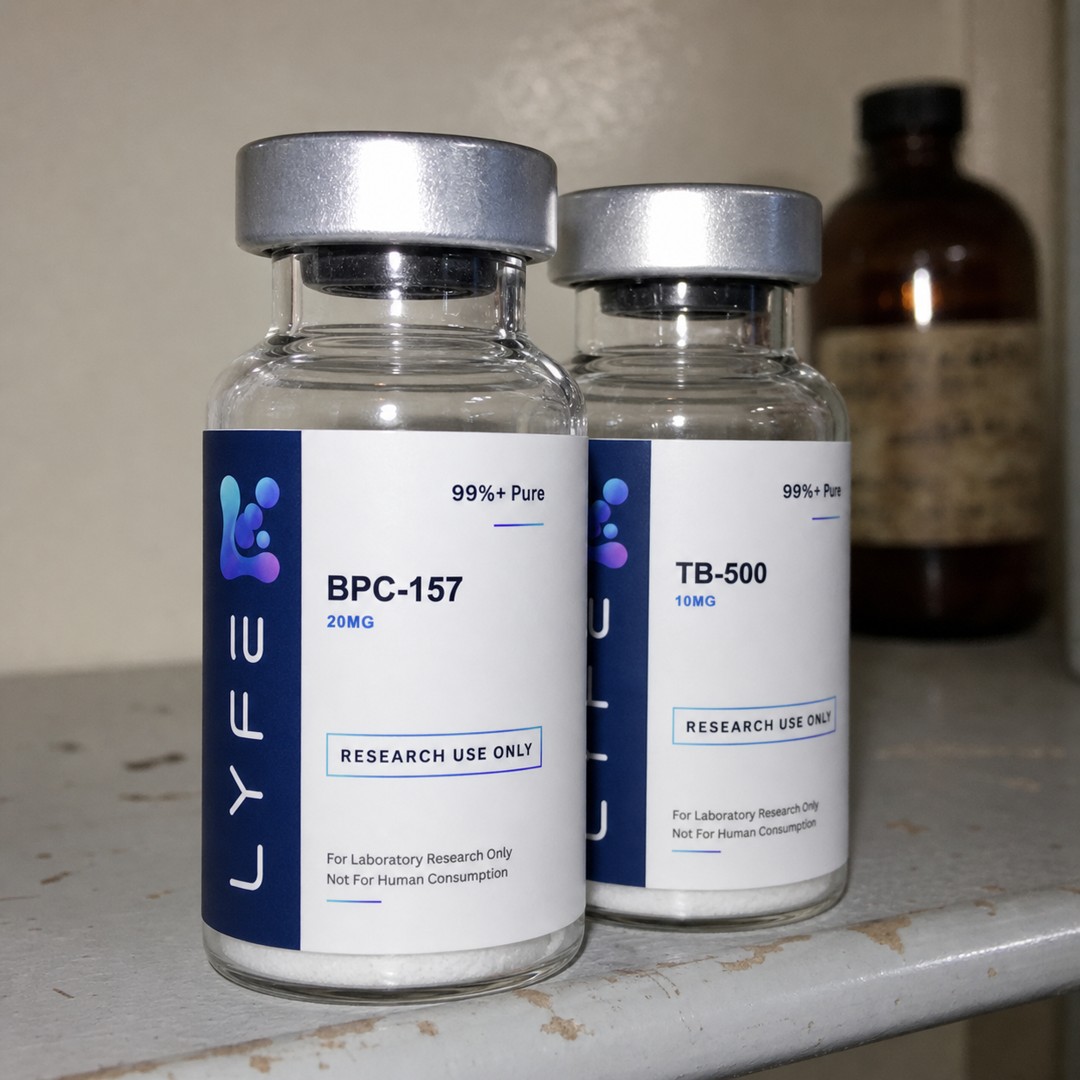
Whichever direction your work takes, the same rule applies: you need to know exactly what is in the vial. LYFE Science carries GHK-Cu and TB-500 as separate, individually characterised products, so you can build your own combinations with full control over identity and ratio rather than trusting a pre-mixed blend of unknown provenance. Every lot is checked by HPLC and mass spectrometry with a certificate of analysis on request.
Every LYFE order ships Canada-wide by Canada Post with same-day dispatch when payment clears before noon ET, and most of the country receives it in one to three business days. Shipping is a flat $25, free once your cart passes $150, and every parcel goes out in plain, neutral packaging. We accept Interac e-Transfer and crypto (BTC, ETH, SOL, USDC, USDT), and every lot is verified by HPLC and mass spectrometry with a certificate of analysis available on request.
Compare our copper peptide against our TB-500 in the cytoskeletal category, or start with the peptide guide. When you want the clean single molecule, it is here.
Follow along
Research, lab-side
@lyfe_science →