Blog
Does Vial Size Affect Peptide Stability?

Anyone comparing research peptides quickly notices that the same compound can arrive in very different vials: a small 2 mL crimp-top, a taller 3 mL, or a wider-mouthed container. A common question follows: does the size of the vial actually change how stable the peptide is inside it? The short answer is that vial geometry matters far less than what the vial protects against, but it is not irrelevant. Understanding the relationship helps you judge quality and store your material properly.
What actually degrades a lyophilized peptide
Most research peptides ship as a lyophilized (freeze-dried) powder. In that dry state they are relatively robust, but they are still vulnerable to a handful of enemies:
- Moisture. Water is the main driver of hydrolysis and aggregation. A dry powder that picks up humidity begins to break down.
- Oxygen. Peptides containing methionine, cysteine or tryptophan can oxidise when exposed to air over time.
- Heat and light. Both accelerate chemical reactions and can degrade sensitive sequences.
- Surface adsorption. A fraction of peptide can stick to the glass wall, which matters more once the material is reconstituted into solution.
Notice that vial size is not on that list directly. Instead, size influences a few of these factors indirectly.
Where vial size and shape do play a role
Headspace and oxygen
The empty volume above the powder is called headspace. A larger vial holding the same small amount of powder has more headspace, and therefore potentially more trapped air and oxygen. Reputable suppliers reduce this by sealing vials under vacuum or backfilling with an inert gas such as nitrogen or argon, which removes oxygen regardless of how tall the vial is. When that step is done well, headspace becomes a non-issue.
Surface area exposure
A wider vial spreads the powder across more glass surface. In the dry state this rarely causes measurable loss, but after reconstitution a larger liquid-to-glass contact area can slightly increase adsorption for peptides that are prone to sticking. This is one reason many concentrated research peptides are supplied in narrow vials.
Seal integrity
The closure matters more than the body. A properly crimped rubber stopper keeps moisture and air out. A loose or punctured seal will compromise stability in any size of vial. When you inspect a delivery, the stopper and crimp are what you should be checking, not the height of the glass.
Fill volume versus vial size
It helps to separate two ideas. The vial size is the container’s capacity. The fill is how much peptide is actually inside. A 30 mg peptide can sit perfectly well in a small vial with almost no headspace, or in a larger vial that leaves room for later reconstitution. Neither is inherently more stable as long as the vial is sealed correctly and stored cold and dry. Vial size is largely a packaging and handling decision, not a stability guarantee.
Storage is what really preserves stability
Regardless of vial dimensions, storage does the heavy lifting:
- Keep lyophilized powder in a freezer for long-term holding, or refrigerated for shorter periods.
- Protect the vial from light and repeated temperature swings.
- Minimise freeze-thaw cycles once a peptide is in solution.
- Keep the seal intact until you are ready to use the material.
How LYFE Science handles it
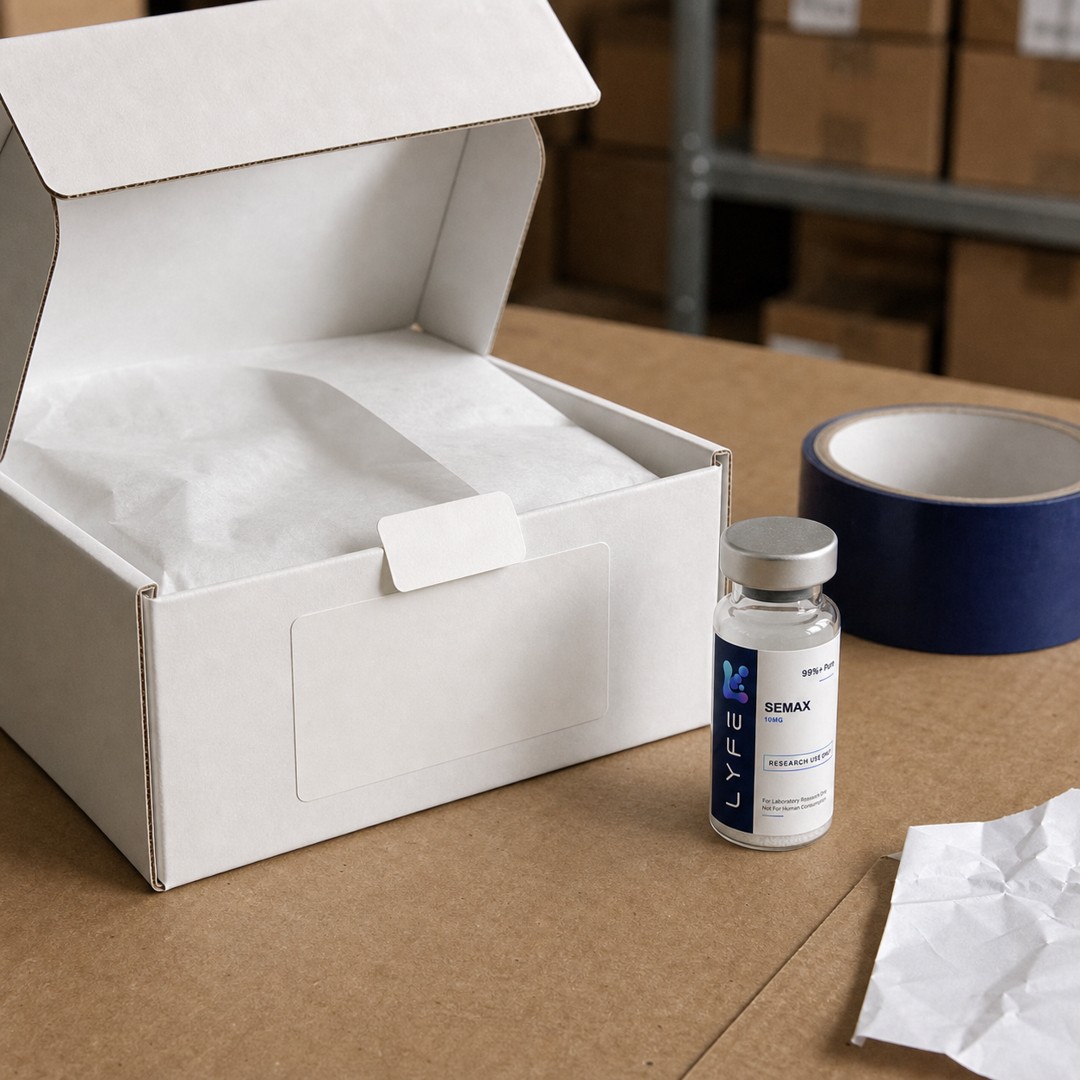
At LYFE Science we treat packaging and handling as part of quality, not an afterthought. Every lot is checked by HPLC and mass spectrometry, and a certificate of analysis is available per lot so you can verify identity and purity of what you received. Orders ship across Canada by Canada Post in neutral packaging, with same-day dispatch when paid before noon Eastern and typical transit of one to three business days for most of the country. Shipping is a flat $25 and free over $150. We accept Interac e-Transfer and crypto (BTC, ETH, SOL, USDC, USDT).
The takeaway: don’t judge a peptide by the size of its vial. Judge it by the seal, the storage conditions, and the documentation behind it. When those are right, both small and large vials keep their contents intact.
Buy research peptides in Canada or read the full peptide guide to learn more about handling and storage.
Follow along
Research, lab-side
@lyfe_science →