Blog
Andrew Huberman on Peptides: What He’s Covered

Few science communicators have done more to bring peptides into everyday conversation than Andrew Huberman. Through the Huberman Lab podcast, he has walked large audiences through the biology of a range of peptides, usually with an emphasis on what the research actually shows versus what gets overhyped. This guide summarises the peptides that have come up and points you to where each fits in the research landscape.
Why the Huberman Lab coverage matters
The podcast’s appeal is its measured tone. Rather than treating peptides as miracle compounds, the discussions tend to separate mechanism from marketing, note where evidence is still early, and stress that much of the data comes from cell and animal models. That framing is a useful starting point for anyone trying to understand these compounds seriously.
Peptides that have come up
Several categories of peptide have featured across episodes. Here is a plain-language map of the main ones.
Growth hormone secretagogues
A recurring theme is the family of peptides that interact with the growth hormone axis, including the combination of a growth-hormone-releasing hormone analogue with a ghrelin-mimetic. In research shorthand, that pairing is often CJC-1295 with Ipamorelin. These are studied for how they influence pulsatile signalling in the growth hormone system, and they are a frequent reference point in discussions of the axis.
Repair and recovery peptides
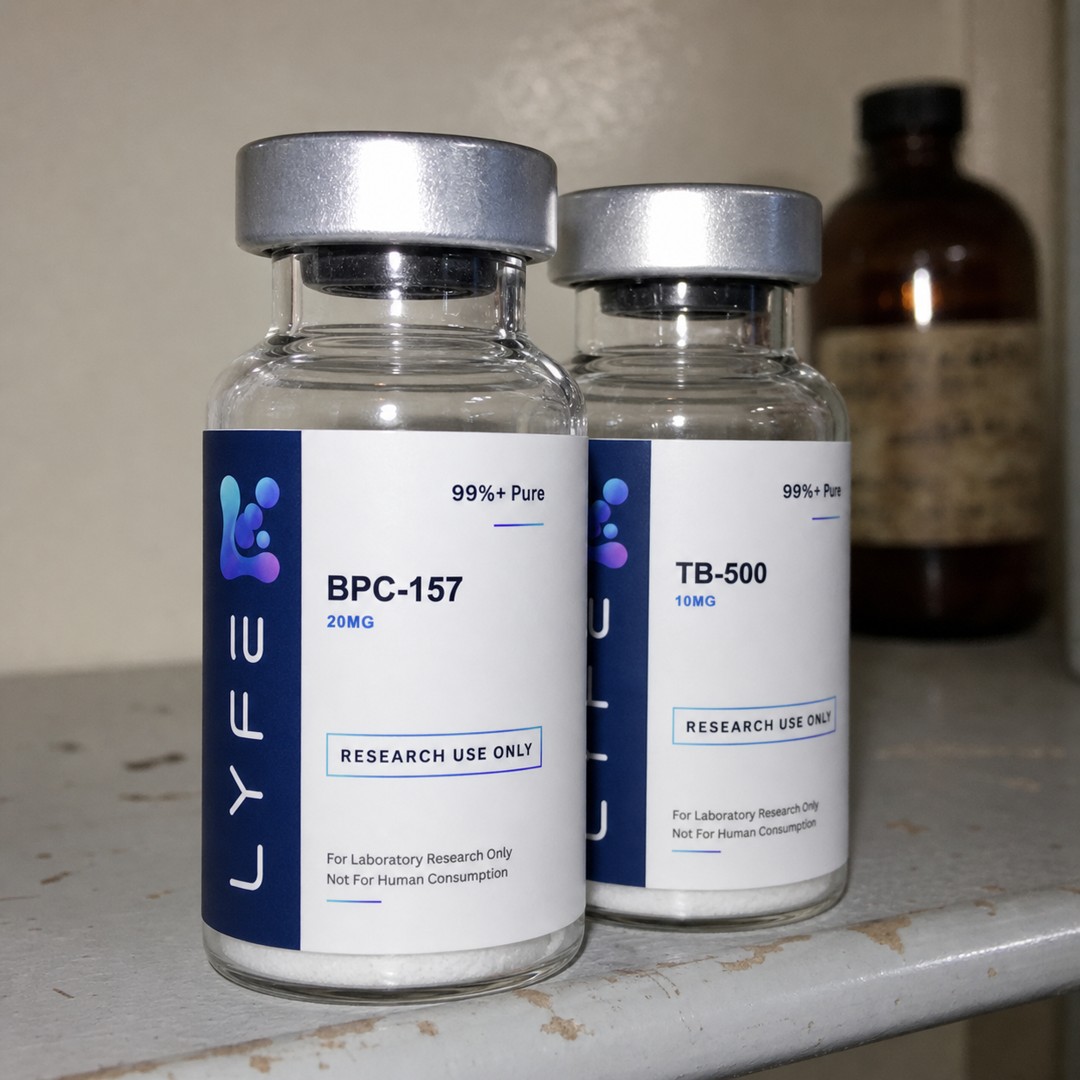
BPC-157 comes up often in the context of tissue repair research. It is a peptide derived from a protein found in gastric juice and is studied in animal models for its effects on connective tissue and the gut. TB-500, a fragment related to thymosin beta-4, is another repair-oriented peptide discussed for its role in cytoskeletal dynamics and cell migration.
GHK-Cu
The copper peptide GHK-Cu is a common topic when the conversation turns to skin, collagen, and aging research. It is a naturally occurring tripeptide that binds copper and has been studied extensively in laboratory models for its effects on the extracellular matrix.
Metabolic peptides
Peptides tied to metabolism, including mitochondrial-derived signals such as MOTS-c, have featured in discussions of energy regulation and exercise biology. These sit alongside the broader wave of interest in metabolic research compounds.
Reading the coverage sensibly
A few points are worth keeping in mind when you revisit any of this material:
- Much of the strongest data is preclinical, from cell and animal studies
- Mechanism is often better established than long-term outcomes
- Compound quality varies widely, so sourcing and verification matter as much as the science
That last point is easy to overlook. A peptide is only as good as its identity and purity, and those have to be confirmed, not assumed. Two vials labelled the same way can differ substantially if one has not been analytically verified, and that difference can quietly undermine an entire set of experiments before you notice anything is wrong. It is the least glamorous part of the process and the one that most often decides whether results hold up.
Sourcing research peptides in Canada
If the Huberman Lab discussions have you wanting to look at these compounds more closely, quality is the place to start. LYFE Science verifies research peptides by HPLC and mass spectrometry, with a certificate of analysis available per lot so you can match documentation to what you receive.
LYFE Science is a Canadian supplier and ships Canada-wide by Canada Post, with flat $25 shipping and free shipping over $150. Orders paid before noon Eastern dispatch the same day, and most of Canada gets delivery within one to three business days. Packaging is neutral, and payment is by Interac e-Transfer or crypto, including BTC, ETH, SOL, USDC, and USDT.
Where to go next
Several of the peptides discussed on the podcast, including GHK-Cu, TB-500, MOTS-c, and the CJC-1295 with Ipamorelin combination, are stocked and documented. Read the peptide guide for a grounded introduction, then browse the full catalogue.
Follow along
Research, lab-side
@lyfe_science →