Blog
What Is NAD+? A Research Guide

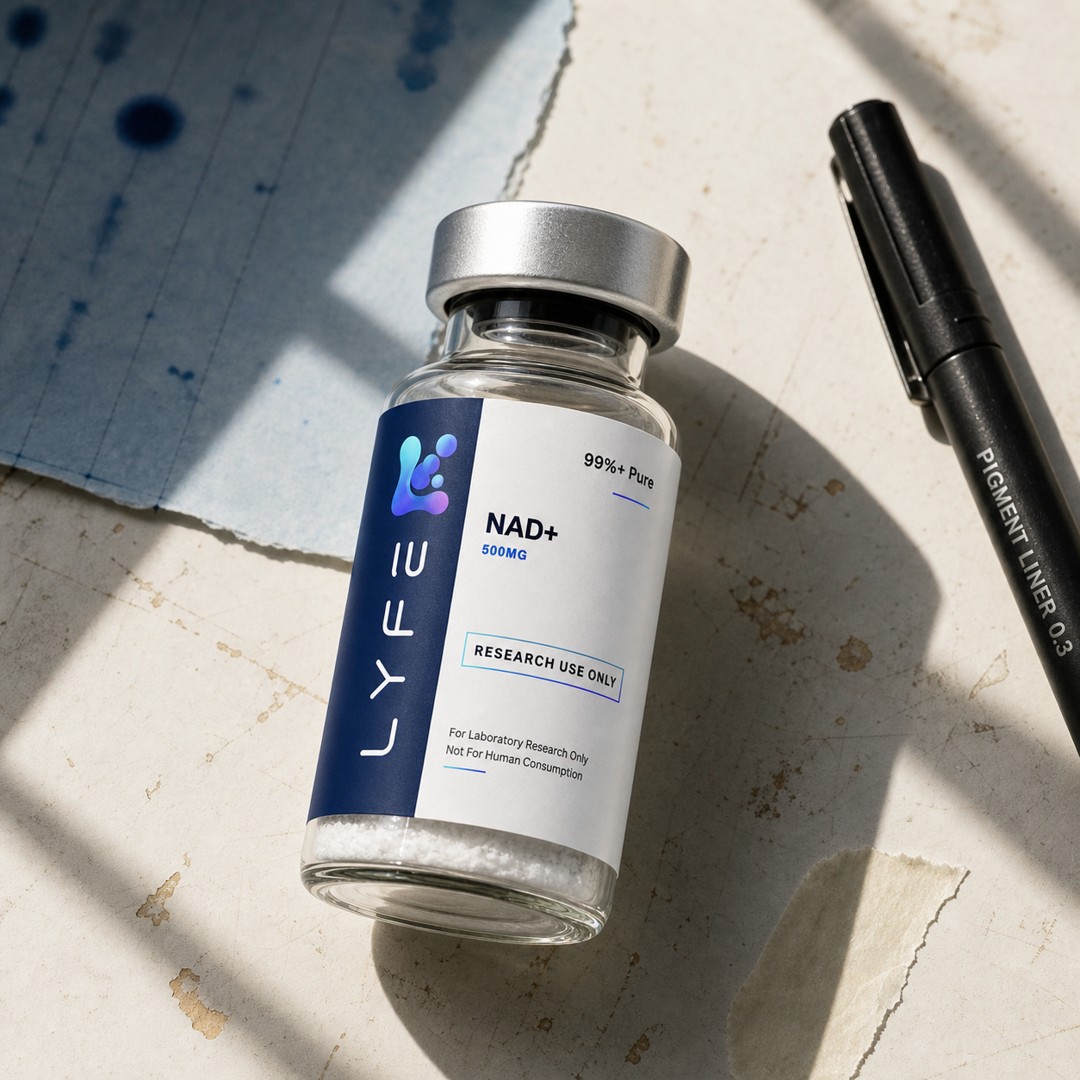
NAD+ (nicotinamide adenine dinucleotide) is one of the most fundamental molecules in biology. It is not a peptide, but a coenzyme found in every living cell, and it sits at the centre of how cells turn food into usable energy. Over the last decade it has become a headline topic in ageing and metabolic research, which is why so many people looking into longevity science eventually come across it.
What is NAD+?
NAD+ is a coenzyme, meaning it partners with enzymes to help chemical reactions happen. It exists in two forms that constantly convert back and forth: the oxidized form (NAD+) and the reduced form (NADH). This shuttling of the molecule between its two states is how cells carry electrons through the reactions that generate energy. Without adequate NAD+, the machinery that produces cellular fuel simply cannot run.
What does NAD+ do?
Researchers study NAD+ across several overlapping roles:
- Energy metabolism – it is essential to glycolysis, the citric acid cycle, and oxidative phosphorylation, the core processes that make ATP.
- DNA repair – enzymes called PARPs consume NAD+ when they repair damaged DNA, tying the molecule directly to genomic maintenance.
- Cell signalling – a family of proteins known as sirtuins depend on NAD+ to function, and sirtuins are heavily studied in the context of ageing and stress resistance.
- Circadian and metabolic regulation – NAD+ levels fluctuate across the day and with feeding, linking it to how cells keep time and balance fuel.
NAD+ and ageing research
A recurring observation in the scientific literature is that NAD+ availability tends to decline with age in many tissues. Because the molecule is so central to energy production, DNA repair, and sirtuin activity, that decline has become a leading hypothesis in the biology of ageing. This is the reason NAD+ is discussed alongside longevity peptides and other compounds studied for metabolic resilience.
NAD+ precursors
Much of the practical research does not use NAD+ directly but instead studies its precursors, the building blocks cells use to make it. The best-known are NMN (nicotinamide mononucleotide) and NR (nicotinamide riboside), both of which sit upstream of NAD+ in the biosynthesis pathway. Investigators use these precursors to explore whether raising the pool of available NAD+ changes how cells and tissues behave under stress or with age.
Why NAD+ matters to peptide researchers
Peptides like MOTS-c that act on cellular energy sensing intersect with the same biology that NAD+ governs. Both connect to AMPK, sirtuins, and mitochondrial function, so understanding NAD+ helps make sense of a whole class of metabolic and longevity compounds. If you are building background knowledge in this area, NAD+ is one of the first pieces of the puzzle.
Handling and storage
Compounds in this area are typically supplied as a lyophilised (freeze-dried) powder, which is the most stable form for shipping and storage. As a general rule in the field, dry material is kept cool and away from light and moisture, and once a compound is brought into solution its stability window narrows considerably. Keeping the accompanying certificate of analysis on file lets you tie each result back to the exact lot you worked with, which is central to reproducible research. These are general handling principles rather than instructions for any particular protocol.
Sourcing research compounds in Canada
Whatever compound your work centres on, sourcing from a Canadian supplier keeps orders inside the country and avoids customs delays. At LYFE Science every lot we carry is verified by HPLC and mass spectrometry, with a certificate of analysis available per lot. Shipping is a flat $25 across Canada by Canada Post, free over $150, in neutral packaging, with same-day dispatch on orders paid before noon ET and one to three business days to most destinations. We accept Interac e-Transfer and crypto (BTC, ETH, SOL, USDC, USDT).
Learn more
Our peptide guide is a good starting point for anyone new to this field, and you can browse our full catalogue in the shop.
Follow along
Research, lab-side
@lyfe_science →