Blog
What Is the KLOW Blend? Peptide Stack Guide

Peptide blends have become one of the most searched topics in the research space, and the KLOW blend sits right at the centre of that interest. If you have seen the name and want to know exactly what is inside it, how it relates to the better-known GLOW blend, and what separates a well-made blend from a poorly documented one, this guide breaks it down clearly.
What KLOW stands for
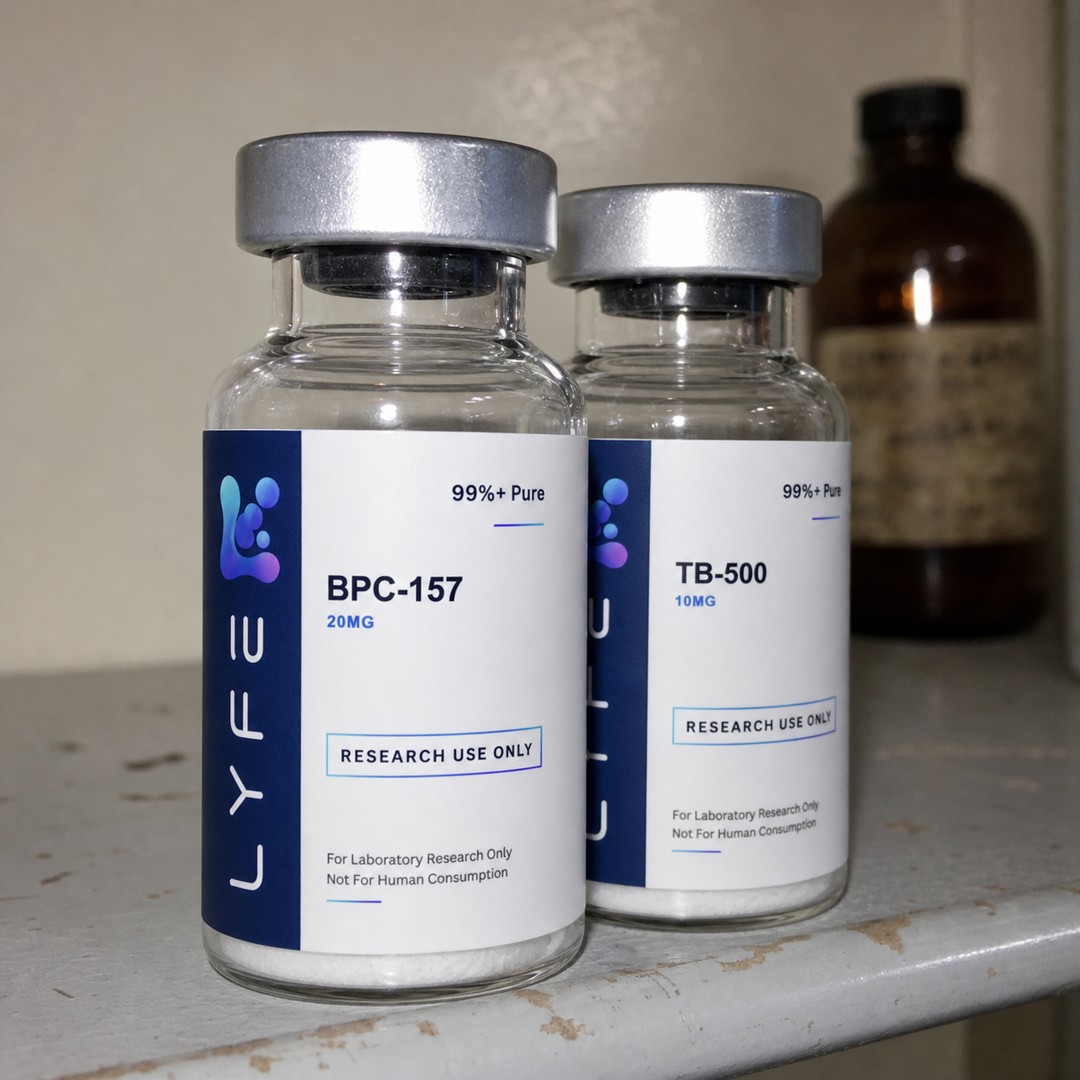
KLOW is a combination product, meaning several individual peptides are formulated together rather than sold on their own. The simplest way to understand it is as an extension of the GLOW blend. GLOW is a three-part combination built around GHK-Cu, BPC-157 and TB-500. KLOW takes that same trio and adds a fourth peptide, KPV. In other words, KLOW is GLOW plus KPV, and the letter K at the front is the tell.
The four components
Each peptide in the blend is studied for a distinct reason, which is why researchers group them together in the first place.
- GHK-Cu is a copper-binding tripeptide made of glycine, histidine and lysine. It is one of the most researched copper peptides and is central to studies on the extracellular matrix and skin-related models. Its bound copper gives solutions a characteristic blue tint.
- BPC-157 is a short peptide originally derived from a protein found in gastric juice. It is one of the most widely discussed compounds in recovery and tissue research.
- TB-500 is a synthetic fragment related to thymosin beta-4, a naturally occurring protein studied in the context of cell migration and the cytoskeleton.
- KPV is a tripeptide (lysine, proline, valine) derived from the tail end of the alpha-MSH hormone, and it is studied primarily in inflammation models.
Grouped together, these four give the KLOW blend its identity: a matrix and copper peptide, two recovery-oriented compounds, and one studied for inflammatory pathways.
KLOW versus GLOW
The distinction is worth being precise about, because the two names are easy to mix up. GLOW is the three-peptide version: GHK-Cu, BPC-157 and TB-500. KLOW is the four-peptide version that keeps all three of those and adds KPV. So every KLOW blend contains everything a GLOW blend does, plus one more component. If you are comparing product listings, the presence or absence of KPV is the single fact that separates them.
Why blends are formulated at all
Combining peptides into a single vial is a matter of convenience and consistency for a research setting. Rather than reconstituting and handling several separate compounds, a blend puts a defined ratio into one product. The trade-off is that the quality of a blend depends on the quality of every peptide inside it, plus the accuracy of the ratio. That makes documentation even more important for a blend than for a single compound.
What to check before you buy a blend
Because a blend is only as good as its weakest component, a few questions separate a serious product from a vague one:
- Is each peptide identified and quantified? A proper listing names all components and the amount of each, not just a total milligram figure.
- Is there a certificate of analysis? Look for a lot-specific COA that reports purity by HPLC and confirms identity by mass spectrometry.
- Does the blue tint make sense? Any blend containing GHK-Cu should carry some blue colour once reconstituted, because the bound copper is what produces it.
- How is it stored and shipped? Lyophilised (freeze-dried) peptides are stable when kept cold and dry, so cold, discreet shipping matters.
Buying research peptides in Canada from LYFE Science
LYFE Science is a Canadian supplier shipping nationwide by Canada Post at a flat $25, free over $150, with same-day dispatch on orders paid before noon Eastern and one to three business days to most of the country. Every lot is checked by HPLC and mass spectrometry with a COA available, orders arrive in neutral packaging, and payment is by Interac e-Transfer or crypto (BTC, ETH, SOL, USDC, USDT).
You can browse the individual components of a KLOW-style stack, including GHK-Cu and TB-500, on our shop page, and our peptide guide explains reconstitution and storage in plain language.
Follow along
Research, lab-side
@lyfe_science →