Blog
Peptides vs SARMs: What’s the Difference?

Peptides and SARMs come up in the same conversations, and the two get blurred together constantly, but chemically they are completely different classes of compound. If you are trying to understand what sets them apart, this explainer lays out what each one is, how they are built, and how they behave, without the marketing noise.
What peptides are
Peptides are short chains of amino acids, the same building blocks that make up proteins. When amino acids link together in a sequence, you get a peptide; longer chains fold into proteins. The body itself uses countless peptides as signalling molecules, and research peptides are studied for the specific ways their sequences interact with biological systems.
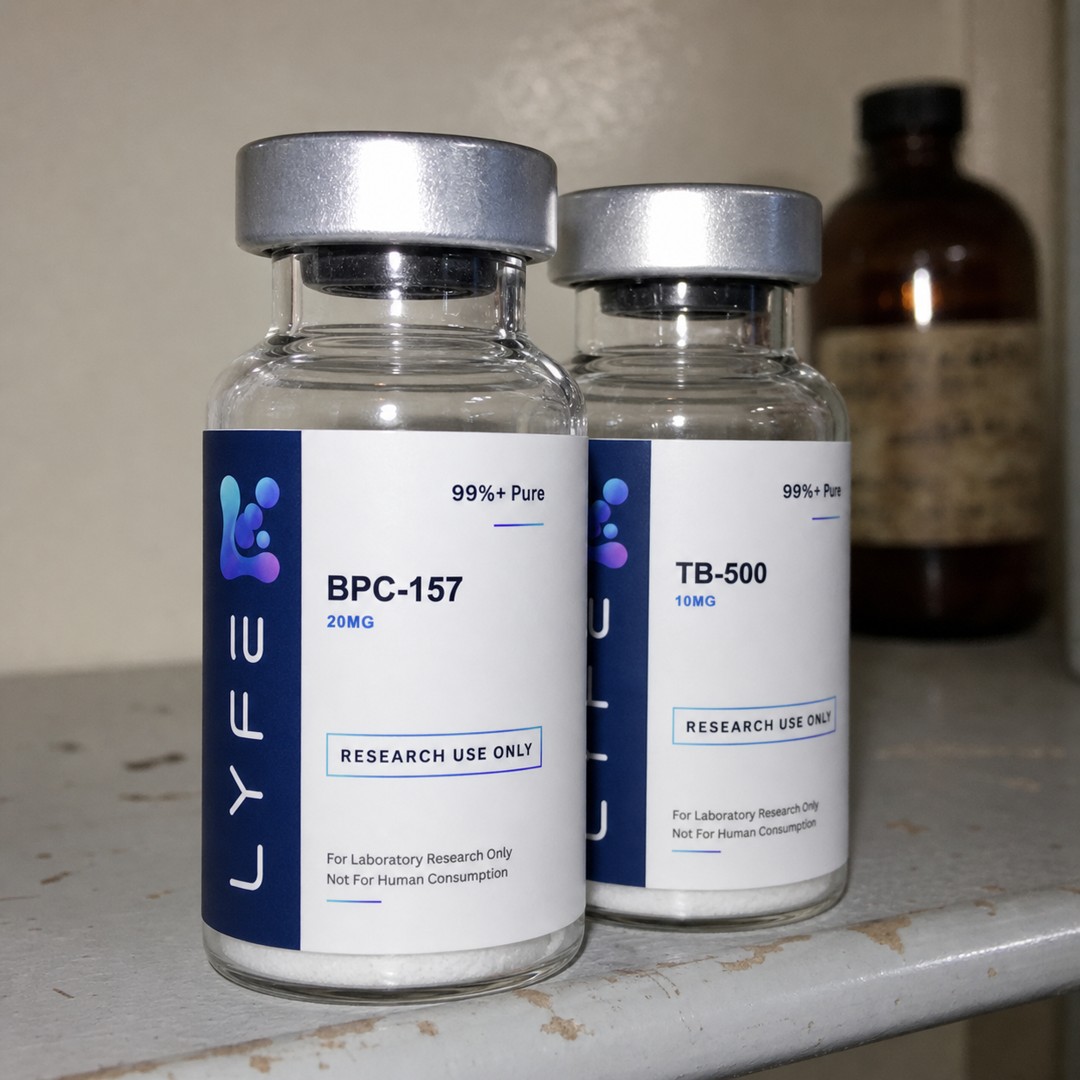
Because they are amino-acid chains, peptides are typically supplied as a lyophilised (freeze-dried) powder and are sensitive to heat, light, and moisture, which is why storage and handling matter.
What SARMs are
SARM stands for selective androgen receptor modulator. Unlike peptides, SARMs are small synthetic molecules, not amino-acid chains. They are designed to interact with the androgen receptor in a targeted way, which is a fundamentally different mechanism from how a signalling peptide works. Chemically, SARMs have more in common with small-molecule research chemicals than with proteins.
The core differences
| Peptides | SARMs | |
|---|---|---|
| Building block | Amino-acid chains | Small synthetic molecules |
| Chemical class | Related to proteins | Non-peptide research chemicals |
| Typical form | Lyophilised powder | Powder or solution |
| Target | Varies widely by sequence | Androgen receptor |
Why they get confused
The confusion is largely a marketing artefact. Both are sold in the same research-chemical corner of the market, both come in small vials or bottles, and both are discussed by people interested in similar research questions. That surface similarity hides a deep chemical difference: one is a chain of amino acids, the other is a designed small molecule.
How each is handled in research
Peptides, being amino-acid chains, generally need cool, dark storage and careful handling because they degrade more readily. Their identity and purity are confirmed by techniques such as HPLC and mass spectrometry, reported on a certificate of analysis. SARMs, as small molecules, are characterised with the analytical methods suited to that class. In both cases, lot-specific testing data is the marker of a serious supplier.
Why the distinction is worth knowing
The difference is more than academic. Because peptides and SARMs are different chemical classes, they are stored, characterised, and studied differently, and they belong to different bodies of research. Lumping them together, as a lot of casual writing does, leads to muddled expectations and poor buying decisions. Knowing which class a compound belongs to tells you how to think about its handling, what testing data to ask for, and where it fits in the research landscape. It also helps you cut through vendor marketing that leans on the two being interchangeable, which they are not.
Which is which at a glance
- If it is a chain of amino acids, it is a peptide.
- If it is a synthetic small molecule aimed at the androgen receptor, it is a SARM.
- They are not interchangeable, and they are not the same category.
Buying peptides in Canada
If peptides are what you are after, LYFE Science is a Canadian supplier shipping Canada-wide by Canada Post: flat $25 shipping, free over $150, same-day dispatch on orders paid before noon Eastern. Every lot is verified by HPLC and mass spectrometry with a COA available per lot, packaging is neutral, and payment is by Interac e-Transfer or crypto. The catalogue is organised by field of research so you can find compounds by the questions they relate to.
New to the topic? The peptide guide covers the fundamentals.
Follow along
Research, lab-side
@lyfe_science →