Blog
Peptide Receptor Families: A Research Map

One of the fastest ways to make sense of the peptide landscape is to stop memorising individual molecules and start grouping them by the receptor or pathway they act on. Most research peptides are signalling molecules: short chains of amino acids that fit a specific receptor the way a key fits a lock. Once you know which family a peptide belongs to, its behaviour, its common pairings, and the reason researchers reach for it all become much easier to predict. This guide is a plain map of the major families and where the best known compounds sit within them.
Why receptor families matter
Two peptides can look similar on paper yet behave completely differently because they bind different receptors. Grouping by family explains why some compounds are almost always studied together (they hit complementary pathways) and why others are effectively interchangeable within a class. It also tells you what to expect from a molecule you have never seen before, simply by identifying its family.
Growth hormone releasing hormone (GHRH) analogues
This family mimics the body’s own GHRH signal, the message that prompts the pituitary to produce growth hormone. The most studied research example is CJC-1295, particularly the No DAC form (also called Modified GRF 1-29), which produces a short, pulse-shaped signal. GHRH analogues raise the amount of growth hormone available to be released, which is why they are rarely used alone.
Growth hormone secretagogues (ghrelin / GHS receptor)
Ghrelin receptor agonists, also called growth hormone releasing peptides (GHRPs), act on a separate receptor from GHRH. Ipamorelin is the classic selective example: it triggers its target pathway and eases the somatostatin brake without the strong off-target signalling of older GHRPs. Because GHRH analogues and ghrelin agonists work on complementary pathways, the two families are frequently paired, and CJC-1295 (No DAC) with Ipamorelin is the best known blend in this space.
Melanocortin receptor peptides
The melanocortin family binds the MC receptors and is studied for its role in pigmentation and appetite signalling pathways. These peptides illustrate how a single receptor system can influence several distinct research areas depending on which receptor subtype is engaged.
Incretin and metabolic receptor peptides
This is the family that has dominated recent attention. GLP-1 and dual or triple agonists act on incretin receptors involved in glucose and energy metabolism. Compounds such as semaglutide, tirzepatide, and retatrutide belong here. Their popularity has driven a lot of the wider interest in peptide science, and they remain some of the most searched research names in Canada.
Peptides that act inside the cell or on structural proteins
Not every peptide binds a surface receptor. Some work on intracellular or structural targets, which is why they do not fit neatly into a receptor family:
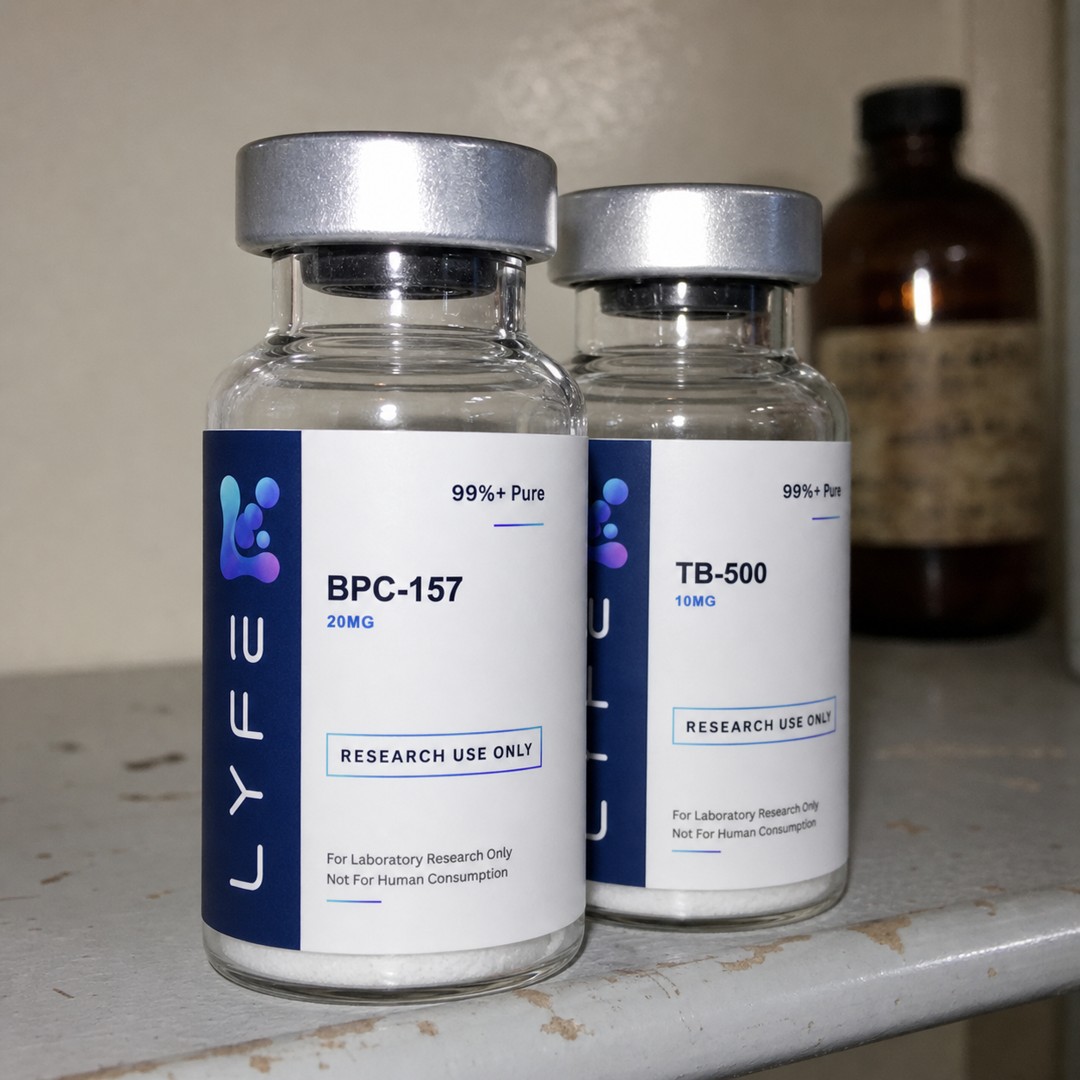
- TB-500 is a synthetic fragment related to thymosin beta-4 and is studied for its interaction with actin, part of the cell’s cytoskeleton, rather than a classic membrane receptor.
- MOTS-c is a mitochondrial derived peptide investigated in metabolic and cellular energy research, acting through intracellular signalling rather than a single surface receptor.
- GHK-Cu is a copper binding tripeptide studied in matrix and skin research; its activity is tied to copper transport and extracellular matrix signalling.
Putting the map together
| Family | Target | Example compounds |
|---|---|---|
| GHRH analogue | GHRH receptor | CJC-1295 (No DAC) |
| Ghrelin / GHS | Ghrelin receptor | Ipamorelin |
| Melanocortin | MC receptors | Melanocortin peptides |
| Incretin / metabolic | GLP-1 and related | Semaglutide, tirzepatide, retatrutide |
| Cytoskeletal | Actin binding | TB-500 |
| Mitochondrial | Intracellular | MOTS-c |
| Matrix / copper | Copper transport, ECM | GHK-Cu |
Sourcing peptides for your research in Canada
Whichever family you are working in, identity and purity are the variables that decide whether a result is meaningful. LYFE Science is a Canadian supplier and confirms identity and purity by HPLC and mass spectrometry, with a certificate of analysis available per lot. We ship coast to coast by Canada Post at a flat $25, free over $150, with same-day dispatch on orders paid before noon Eastern and delivery to most of Canada in one to three business days. Packaging is plain and neutral, and we accept Interac e-Transfer and crypto (BTC, ETH, SOL, USDC, USDT).
New to the field? Our peptide guide walks through the basics, and the full catalogue by research area lives on the shop page.
Follow along
Research, lab-side
@lyfe_science →