Blog
KLOW vs GLOW: Peptide Blends Compared

KLOW and GLOW are two of the most searched peptide “blend” names, and because they share most of their ingredients, they are easy to mix up. The difference between them comes down to a single added component. This guide breaks down what each blend contains, how they compare, and why many researchers skip pre-mixed vials in favour of single, characterised compounds.
What GLOW contains
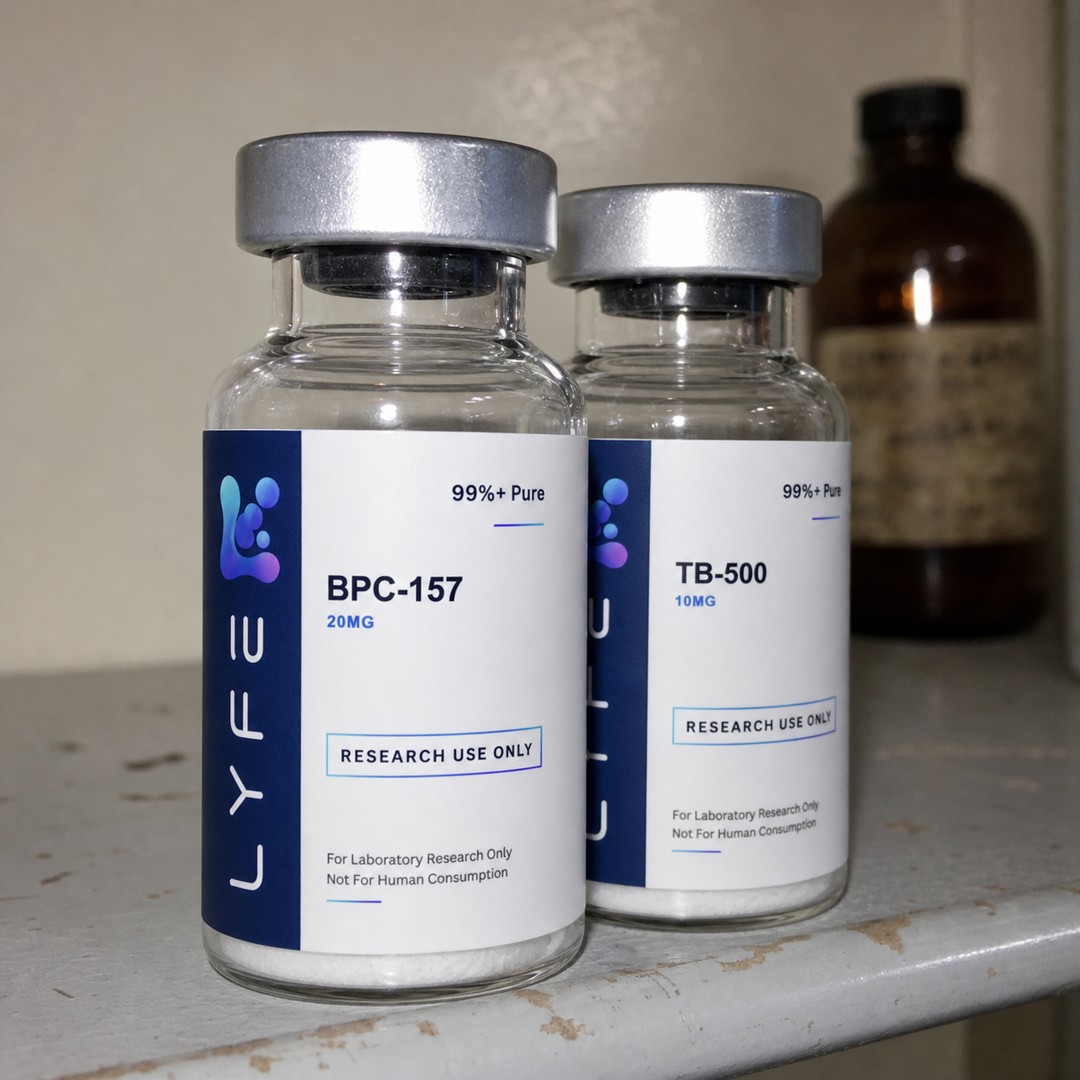
GLOW is a marketing name for a blend that typically combines three research peptides in one vial: GHK-Cu, BPC-157 and TB-500. GHK-Cu contributes the copper-peptide component, BPC-157 is studied in tissue-repair and gut models, and TB-500 is studied in cytoskeletal and cell-migration contexts. The appeal is convenience: three peptides, one reconstitution.
What KLOW contains
KLOW is essentially GLOW with one addition: KPV. So a KLOW blend typically combines KPV, GHK-Cu, BPC-157 and TB-500. KPV is a short tripeptide fragment derived from alpha-MSH, studied largely in inflammation-related models. In other words, KLOW is the four-peptide version and GLOW is the three-peptide version of the same basic idea.
KLOW vs GLOW at a glance
| Component | GLOW | KLOW |
|---|---|---|
| GHK-Cu | Yes | Yes |
| BPC-157 | Yes | Yes |
| TB-500 | Yes | Yes |
| KPV | No | Yes |
| Number of actives | Three | Four |
The trade-off both blends share
Whichever you look at, the same limitation applies. A blend fixes multiple peptides at set ratios in one solution, which means you cannot isolate the contribution of any single component and you cannot adjust one without touching the rest. For any careful comparison, folding three or four variables into one vial is the opposite of a clean experiment. A blend also makes verification harder: each active has to be resolved and quantified separately, rather than confirmed with one clear mass-spectrometry signature and one purity figure.
Why single compounds usually win
Buying each peptide on its own gives you full control. You choose the ratios, you can study one variable at a time, and every vial comes with a single, easy-to-verify COA. If your interest is the copper-peptide biology GHK-Cu is known for, or the cytoskeletal research around TB-500, a pre-mixed blend simply adds noise. For definitions of tripeptide, reconstitution and COA, our peptide guide explains the basics.
A note on the extra component
The single thing that separates KLOW from GLOW is KPV, so it is worth understanding on its own. KPV is a tripeptide fragment (lysine-proline-valine) taken from the tail end of the alpha-MSH hormone, and it is studied mainly in inflammation-related models rather than the tissue-repair themes associated with BPC-157 and TB-500. That is a meaningfully different research area, which is another argument against treating the two blends as interchangeable: KLOW is not simply a “stronger GLOW,” it introduces a component studied for a different purpose. If KPV is what you actually want to look at, sourcing it separately lets you study it without three other peptides in the background.
Verification is easier one at a time
There is a practical testing angle too. Confirming a single compound is straightforward: one expected molecular mass, one HPLC purity number, one clean certificate. Confirming a four-peptide blend means resolving and quantifying each active separately, which is more work and leaves more room for error. When identity and purity matter, fewer moving parts is always the safer position.
Sourcing the components in Canada
Rather than a fixed blend, LYFE Science carries the individual research peptides as single, characterised compounds, including GHK-Cu and TB-500, each checked by HPLC and mass spectrometry with a COA available per lot.
Sourcing peptides in Canada
LYFE Science is a Canadian supplier shipping nationwide by Canada Post, with flat $25 shipping and free delivery on orders over $150. Orders paid before noon ET dispatch the same day and reach most of Canada in 1-3 business days, in neutral packaging. Every lot is checked by HPLC and mass spectrometry, with a COA available per lot. We accept Interac e-Transfer and crypto (BTC, ETH, SOL, USDC, USDT).
Browse the copper-peptide category and check availability below.
Follow along
Research, lab-side
@lyfe_science →