Blog
GHK-Cu and Wound Healing: Research Overview

Of all the contexts in which GHK-Cu appears in the scientific literature, tissue remodelling and wound-healing models are among the oldest and most cited. This overview explains why the copper tripeptide became a reference compound in that field, what the research actually examines, and what to look for when sourcing GHK-Cu for laboratory work in Canada.
A naturally occurring peptide
GHK is a tripeptide, glycyl-L-histidyl-L-lysine, that occurs naturally in human plasma and binds copper with high affinity to form GHK-Cu. Its plasma level is highest in youth and falls with age. That age-related decline is one of the observations that first drew researchers to study it in the context of tissue turnover, where copper availability and matrix rebuilding both matter.
What the research looks at
Wound-healing and remodelling studies with GHK-Cu are largely built on cell-culture and animal models. Common themes in that work include:
- Extracellular matrix: how the peptide influences the proteins that form structural scaffolding in tissue.
- Copper delivery: the peptide’s role as a copper carrier, since copper is a cofactor for enzymes involved in matrix formation.
- Cell signalling and gene expression: changes in the activity of genes tied to tissue repair and remodelling.
- Angiogenesis-related pathways: signalling connected to the formation of new microvasculature in model systems.
It is important to frame this honestly. These are mechanistic findings in controlled models. They explain why GHK-Cu is a useful and reproducible tool for studying repair biology; they are not evidence of a defined result in humans, and this article gives no dose or usage instructions.
Why the copper matters
The distinguishing feature of GHK-Cu compared with a plain peptide is the bound copper ion. Copper participates in the enzymatic cross-linking that gives connective tissue its strength, so a peptide that both signals and delivers copper is a natural object of study in remodelling contexts. Practically, it also means quality control has to confirm the copper complex is intact, not just that the peptide sequence is present.
Handling and stability
Copper peptides reward careful handling. In lyophilised form GHK-Cu is stable when kept cool and dry, but once reconstituted it should be treated as a working solution: protected from light, kept cold, and used within a sensible window. Because the copper centre is redox-active, poor storage can shift the very chemistry a remodelling study is trying to measure. Consistent handling between experiments is part of what makes results comparable, which is another reason to start from a well-characterised, single-source lot rather than material of unknown history.
Choosing a GHK-Cu source
| Requirement | What it protects |
|---|---|
| Mass-spec confirmation of the Cu complex | You are studying GHK-Cu, not degraded peptide |
| HPLC purity figure | Reproducibility between experiments |
| Per-lot certificate of analysis | Traceability to the exact vial |
| Neutral, prompt Canadian shipping | Peptide integrity on arrival |
Buy GHK-Cu in Canada
LYFE Science supplies GHK-Cu to Canadian researchers with identity and purity verified by HPLC and mass spectrometry, and a certificate of analysis available for your lot. It ships from within Canada, so there is no border delay or customs uncertainty on your order.
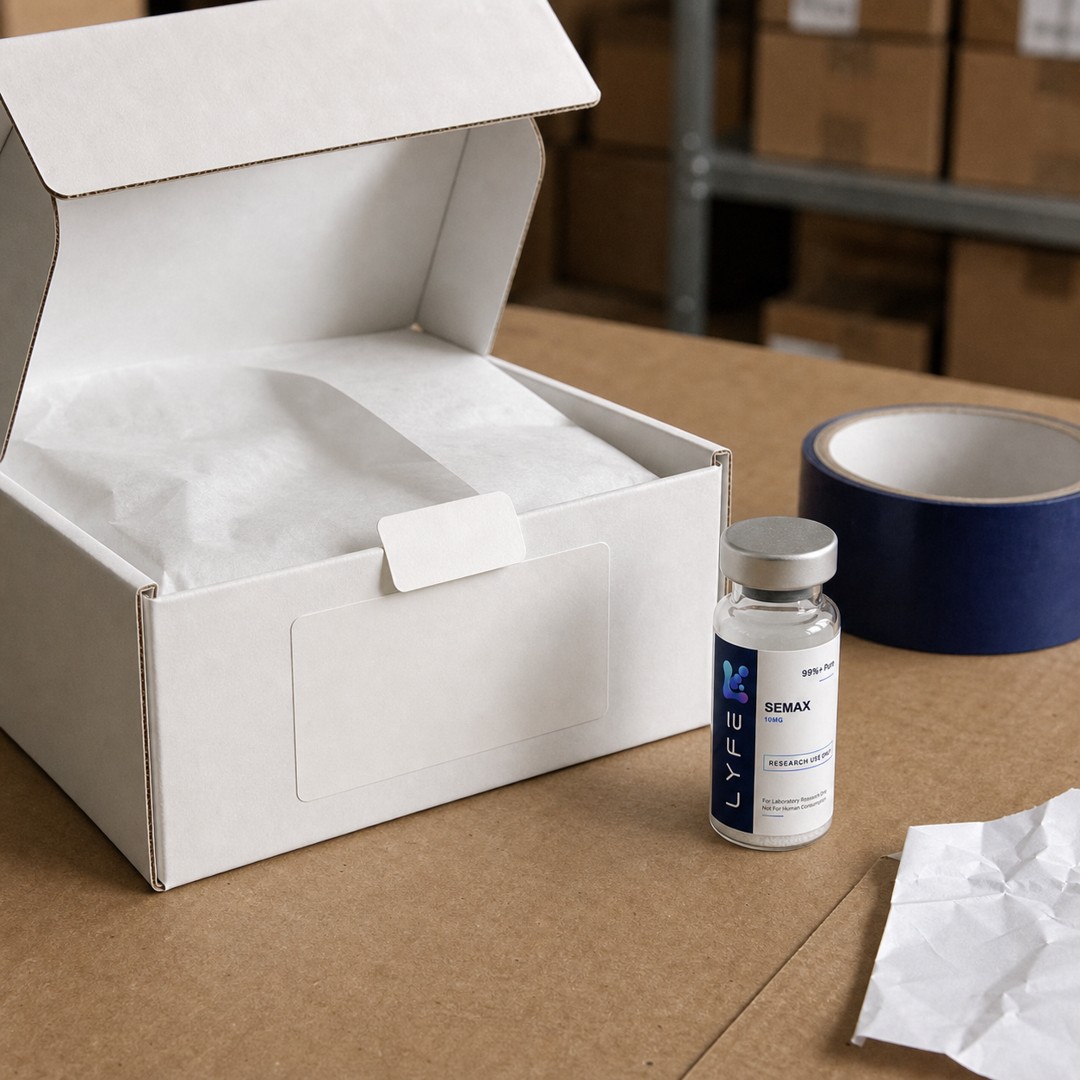
Every LYFE order ships Canada-wide by Canada Post with same-day dispatch when payment clears before noon ET, and most of the country receives it in one to three business days. Shipping is a flat $25, free once your cart passes $150, and every parcel goes out in plain, neutral packaging. We accept Interac e-Transfer and crypto (BTC, ETH, SOL, USDC, USDT), and every lot is verified by HPLC and mass spectrometry with a certificate of analysis available on request.
For a plain-language primer on how peptides like this are handled in the lab, see the peptide guide, or browse everything on the shop. GHK-Cu sits in our matrix and copper research category.
Follow along
Research, lab-side
@lyfe_science →