Blog
BPC-157 Shelf Life and Expiration: FAQ

One of the most common questions about BPC-157 is how long it lasts. Shelf life depends heavily on the form the peptide is in and how it is handled. This FAQ answers the questions researchers ask most.
Does BPC-157 have a shelf life?
Yes. Like all peptides, BPC-157 does not last forever. How long it stays intact depends on whether it is in its dry, lyophilized (freeze-dried) form or has been reconstituted, and on the conditions it is kept in.
How long does lyophilized BPC-157 last?
In its sealed, freeze-dried state, BPC-157 is at its most stable. Kept cold and dry, lyophilized peptide holds up over an extended period, which is why it is shipped and stored in this form. The dry powder has no water for reactions that break the molecule down, so it is far more forgiving than a solution.
How long does reconstituted BPC-157 last?
Once a peptide is in solution, its clock speeds up. A reconstituted peptide has a much shorter usable window than the dry form because water enables the chemical processes that degrade it. Keeping a reconstituted vial consistently cold is the single biggest factor in how long it stays good.
What shortens BPC-157 shelf life?
- Heat. Warm temperatures accelerate degradation.
- Repeated temperature swings. Cycling between warm and cold is harder on a peptide than steady cold.
- Light. Prolonged light exposure can contribute to breakdown.
- Moisture in the dry form. A compromised seal lets humidity reach the powder.
What are the signs of degradation?
Visual cues can hint at a problem: cloudiness, particles or discolouration in a solution that should be clear are reasons for caution. That said, the eye cannot confirm purity. The only reliable way to know a peptide’s condition is analytical testing, which is why a certificate of analysis for the lot matters. A clear-looking solution can still have degraded, and a lot that looks fine on the surface may not match its label, so appearance is a warning system rather than a guarantee.
Does an expiry date tell the whole story?
Not on its own. An expiry or best-by date assumes proper storage the entire time. A peptide kept warm or cycled repeatedly between temperatures can degrade well before its date, while one held steadily cold and sealed may stay in good shape right up to it. The date is a guide that only holds if the handling behind it held. This is why how a peptide was stored and shipped before it reached you matters as much as any printed number.
Shelf life at a glance
| Form | Relative stability | Key rule |
|---|---|---|
| Lyophilized, sealed | Longest | Keep cold, dry and sealed |
| Reconstituted | Much shorter | Keep consistently cold |
Start with a fresh, verified lot
Shelf life starts the moment a peptide is made, so a fresh, properly tested lot gives you the longest usable window. Buying from a Canadian supplier with quick, cold shipping means less time in transit before the material reaches you.
Every lot we sell is checked by HPLC and mass spectrometry, and a certificate of analysis is available for the lot you receive, so you can confirm identity and purity before anything leaves the freezer.
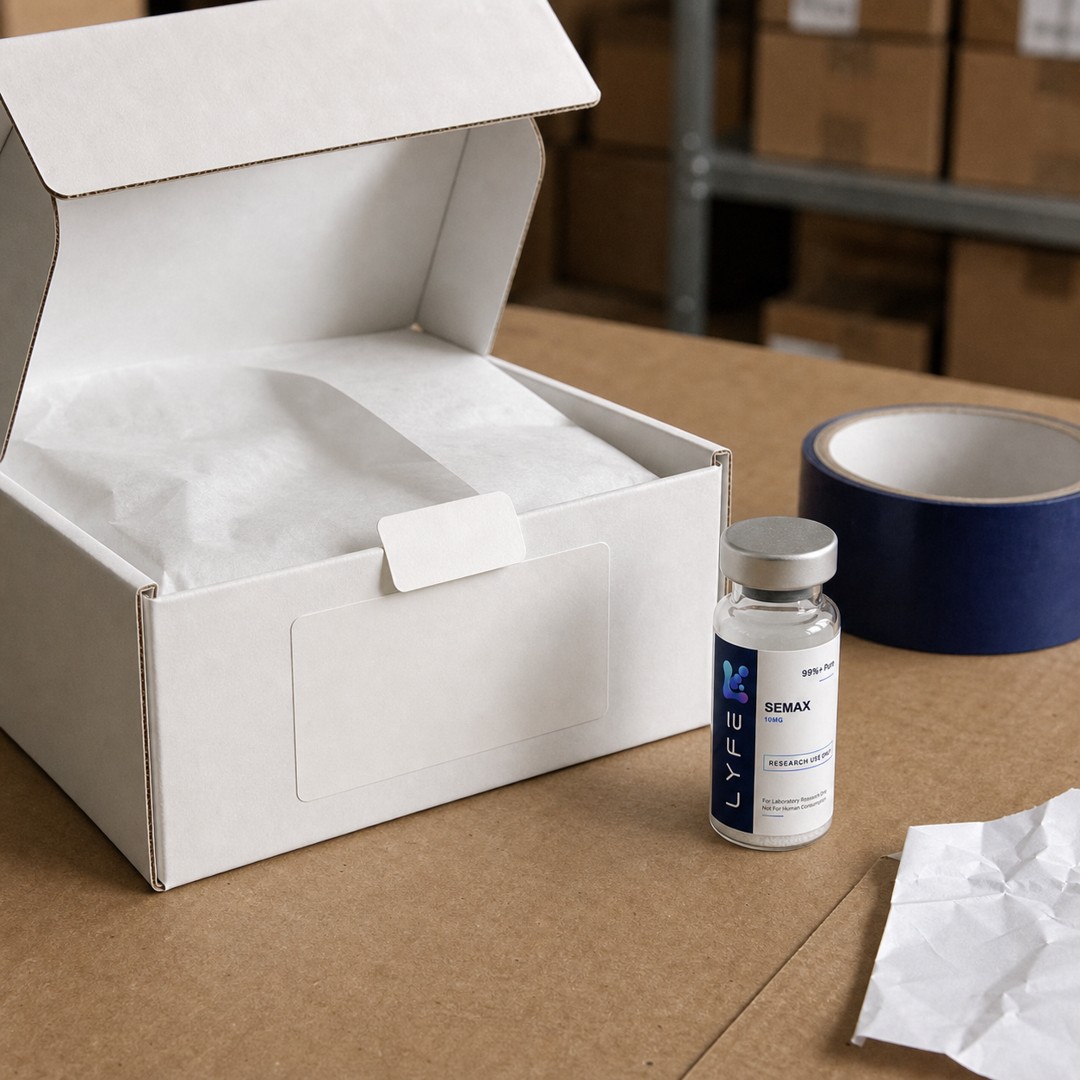
LYFE Science is a Canadian supplier and ships peptides Canada-wide with Canada Post. Shipping is a flat $25, and free on orders over $150. Pay before noon Eastern and your order is dispatched the same day, with most Canadian addresses reached in one to three business days. Every shipment goes out in neutral, unbranded packaging.
Checkout is by Interac e-Transfer or crypto (BTC, ETH, SOL, USDC, USDT). No cards are needed, and no third-party processor sits between you and your order.
LYFE Science is expanding its research catalogue. Check the shop for current, freshly tested lots.
Follow along
Research, lab-side
@lyfe_science →